
© Sweetescape
Meet the Curator: Holly Freeman
Holly graduated from University of Birmingham with a BA (Hons) in Art History & Curation, and has since honed her skills in senior sales and marketing roles, notably in commercial galleries such as Clarendon Fine Art.
Specialising in 20th century contemporary masters, Holly has worked with prominent artists such as Damien Hirst, Banksy and Picasso. At Artelier, Holly supports curation, conducts art research and develops client relationships.

A Discussion on the Australian Contemporary Art Scene
© Visit Victoria
What areas of the art world, styles or ways of working are you particularly drawn to?
Coming from a background in History of Art, history has always felt particularly significant. Understanding history allowed me to pinpoint social responses to artistic practice. I guess when looking at art, I’ve always been interested in the ‘why’. Why did the artist use such intense colour, or perhaps why did they avoid certain colours? Other questions, like why did the artist feel an emotional pull to the subject matter? The answers were always found in historical narratives.

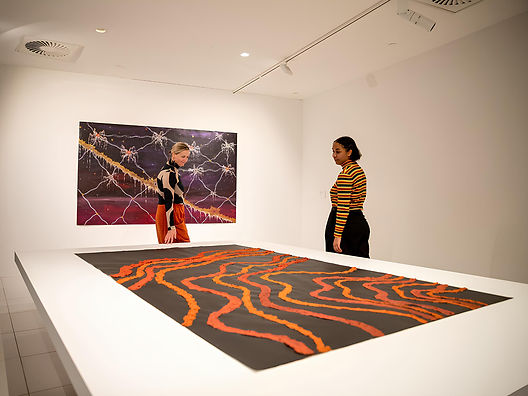
'Mun-Dirra' (2023), by Doreen Jinggarrabarra, Freda Ali Wayartja, Freda Ali, Indra Prudence, Zoe Prudence, Gabriella Garrimara, Maureen Ali, Jennifer Prudence, Anthea Stewart, Bonnie Burarngarra, Lorna Jingubarrangunyja, Michelle Baker, Cecille Baker.

Why did you choose this location for your trip?
Australia holds a special place in my heart. I lived there for a year, in Melbourne actually, exploring its culture, diversity and of course, its beaches. But also, the city is a melting pot of different cultures and communities, each celebrated in its own way. During my time there, I learned a lot about the indigenous community. Australia (Melbourne in particular) has really absorbed the celebration of First Nations* communities and beyond.
I saw such a stark difference from the competitive art scenes we have across the UK, Europe and in the US. I felt as though the geographical isolation of Australia actually made space for a recognition of local talent. Comparatively to the UK, the removal of Western influence allowed local talent to have a voice. This is why it felt like the perfect location to revisit. Its celebration of local, marginalised talent was more important than the consumption of Western ‘pop’ artists. After all, prior to Australia being colonised in 1788, Indigenous art was embedded in the natural landscape for over 50,000 years. Western art tends to be purely visual, but for many Indigenous communities, it had a functional purpose for crafting rafts and connecting with spiritual beings, amongst more. This intrigue in functional art and craft had a huge impact on my trip.
*First Nations individuals are those of indigenous heritage. They are recognised by the Australian government as the original owners of the land.

Melbourne, Swanston Street, 1929

Artelier curator trip in the city of Melbourne, Australia

The exhibition 'Connection' (2023), THE LUME, Melbourne

Lisa Waup 'Family' (2020) © Rochelle Eagle


Craft Victoria, 'DONE/ UNDONE' (2025-26) © Pier Carthew
Craft Victoria © Visit Victoria

Craft Victoria © Visit Victoria

Jodie Fried, 'Sum of Parts' (2025-26)
Describe how the works you’ve seen were curated
There’s a gallery in Melbourne that particularly stood out for me when it came to curation. Slightly off the beaten track, you will find Craft Victoria. Operating as an exhibition space for local craft talents, as well as a functioning gallery where works can be purchased, this space offers a completely unique curatorial display.
The curatorial technique here is not one you see often in gallery exhibition spaces. This one felt absent of rules. Much of the work on display was placed functionally in the form of a coffee table or stool, while some artworks were displayed more traditionally on walls for balance. For example, you can find the placement of Jodie Fried’s ceramic vases in abundance across the gallery floor. Their placement felt dysfunctional, however, it allowed me to see craft as more than ornamental.

Tais Rose Wae, 'Stone Spirit, From Upon the Silver Bank' (2025) © Craft Victoria

Craft Victoria, 'DONE/ UNDONE' (2025-26) © Pier Carthew

Which artwork stood out to you and why?
Women & Water
One piece was greatly influential on me during my time in Melbourne – ‘Iuk bagurrk gunga’ (2023). It was hidden in plain sight on the exterior of the National Gallery of Victoria, nestled into the gallery’s water feature, which surrounded the building. The piece is by First Nations artist, Aunty Kim Wandin. Wandin is a Wurundjeri Woi-wurrung woman, and her ancestors are the traditional owners of the land surrounding the Birrarung (the Yarra River, which runs through Melbourne) and the wider region.
The sculpture's title translates to ‘eel women catch’, a powerful tribute to First Nations women and to the matrilineal weaving practices passed down through female generations. These tools are recognised as profoundly significant, dating back thousands of years. They are seen as one of the oldest and most sophisticated aquaculture systems in the world.
Australian Centre for Contemporary Art © John Gollings

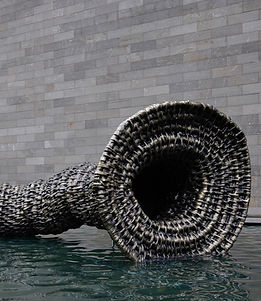

'Iuk bagurrk gunga’ (2023), Aunty Kim Wandin © The National Gallery of Victoria, Sean Fennessy
Expressions of a City
Moving street-to-street in the Central Business District, I uncovered narrow passageways abundant with the life of the inner city. One path led me to Hosier Street, known to locals as Graffiti Lane.
Surrounded by the city’s towering skyline, the street offers an urban edge to the pristine city. You are shrouded by impactful street art, some silly, but some displaying exceptional talent. It feels unexpectedly removed from its urban context, offering a sense of discovery that contrasts with its central location. The standout piece here was definitely 'Paint UP' (2014), portraying an indigenous boy by celebrated Melbourne street artist, Adnate. You can find his colourful celebrations of indigenous people across Melbourne.

Hosier Lane, Melbourne

© Matt Adnate


Exhibition on Reko Rennie (2019) © Sydney Contemporary

Lisa Waup, 'Continuum' (2020) © Henry Trumble

Emily Kam Kngwarray Exhibition at the Tate Modern © Tate Modern
'Bark Salon' featuring various Aboriginal artworks on bark © National Gallery of Victoria
Did any aspect of the trip surprise you?
Aboriginal and Torres Strait Islander Peoples
Definitely. One of the most unexpected and thought-provoking aspects of the trip was observing how First Nations history is increasingly being recognised in Melbourne’s public cultural spaces. Aboriginal and Torres Strait Islander peoples are the original owners of the land on which Melbourne stands, with their connection and occupation predating colonisation by tens of thousands of years. Their institutional recognition is only recent, with legislation such as the Aboriginal and Torres Strait Islander Peoples Recognition Act 2013. This act recognises that they are the first inhabitants of Australia and refers to proposals for changes to the Australian Constitution. It was fascinating to learn more about their culture and history through various craft techniques that can be found throughout the city.

Indigenous rights campaigner Margaret Briggs-Wirrpanda (Wurundjeri), NAIDOC week, 1988 © Sue Ford

First Nations Artist, Jenna Lee © James Westland

'Scar - A Stolen Vision' (2001) © City of Melbourne
Indigenous Craft
During my stay in the city, I developed a deeper appreciation for the artistry and craftsmanship of First Nations people, an area of the art world I had not previously explored in depth. For example, there is the craft of tree scarring and bark painting. These traditional practices, which involved removing bark or wood to create art and craft, have resulted in scarred trees that serve as living artefacts and now act as markers of cultural ownership. Colonisation hugely disrupted these traditions.
Today, the growing recognition and celebration of First Nations craft within public spaces and community events is a vital acknowledgement of both their lasting presence and the significance of their cultural heritage. This recognition can be seen across Melbourne, from plaques and murals to dedicated website content, all affirming First Nations peoples as the original inhabitants of the land. Events such as Wurundjeri Week and NAIDOC Week (National Aborigines and Islanders Day Observance Committee) celebrate First Nations culture, offering communities the opportunity to reflect on achievements, engage with music and art, and celebrate Indigenous communities.
Striking public artworks further show this commitment, such as ‘Scar: A Stolen Vision’ (2003), a collaborative piece by First Nations artists that honours the practice of tree scarring. Works like these, along with community events, provide meaningful opportunities for exposure and engagement with First Nations culture, reinforcing its continued relevance in Australia’s contemporary art landscape.
*Aboriginal and Torres Strait Islander Peoples are the distinct Indigenous descendants of Australia’s first inhabitants, collectively recognised as First Nations Australians.

"In the creation of public art, the City of Melbourne will foster appropriate engagement with the critical knowledge, values and insights of the Wurundjeri Woi Wurrung and Bunurong Boon Wurrung peoples of the Eastern Kulin. We commission public art informed by the values and insights of Traditional Owners."
Statement from City of Melbourne
Scarred Tree, Fitzroy Gardens, Melbourne © City of Melbourne
Do you see the works being relevant in today’s context?
Absolutely. As the protection and appreciation of indigenous art forms continue to grow across Australia, institutions celebrating their practice grow simultaneously. Craft Victoria, in particular, has become a growing outlet for indigenous communities to affirm their history. This is why institutions like Craft are fundamental players in the re-establishment of First Nations culture, from exhibiting contemporary indigenous artworks to showcasing indigenous talent.
Each exhibition at Craft feels carefully considered, often displaying themes of lineage, place, and identity. This made works like ‘Iuk bagurrk gunga’ (2023), the bronze eel sculpture, feel even more interconnected and relevant. I look forward to seeing the continued collaborations with First Nations individuals, where space is being made to reintroduce indigenous craft. As a tourist and observer, I am optimistic about seeing how this revival develops, with the aim of empowering indigenous communities even further.
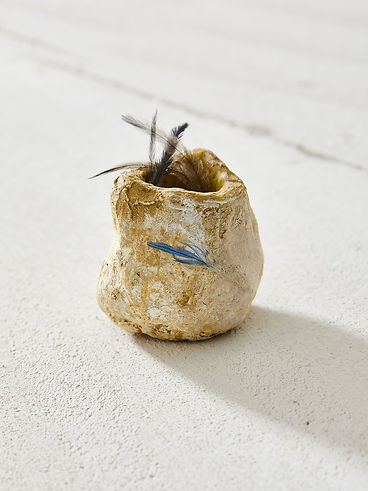
Cassie Leatham, 'Clay Pot #3, Derril Mon Daanak' (2021) © Craft Victoria


'Scar - A Stolen Vision' (2001) © City of Melbourne
Lisa Waup, 'Coming Together' (2024) © Claire Armstrong


