Corners of the Art World: Bali
Updated: Aug 20
Welcome back to Artelier’s roaming series on contemporary artists and the places that shape them. This year, we land in Bali, Indonesia – just 0.2% of the archipelago, and yet wildly amplified in the global imagination.
Research & words by Calypso Lyhne-Gold

Introduction
In the blue hours before sunrise, on a tiny island blooming with frangipani and sacred banyan trees, Bali wakes to the smell of incense. Small woven palm-leaf baskets, canang sari, are filled with flowers, rice and smoke and set down almost everywhere: outside homes, on temple steps, at crossroads, by drains. Even motorbikes are blessed, their handlebars carrying a bright scattering of petals through the day. The offerings are placed in gratitude to deities living in all objects and places for the universe's gifts of life and harmony.
Balinese traditions – mythological, spiritual and preserved over generations – shine throughout daily life on the island, interspersing with its daily traffic. Whether that's poleng, the black-and-white chequered cloth wrapped around trees and charged thresholds symbolising balance amidst life's light and dark, or the intricate shrines nestled into auspicious corners of family compounds and temples. It's a deep part of Tri Hita Karana philosophy that is embedded into Bali, referring to harmony amongst people, harmony with nature and harmony with God.
It is part of why Bali has become one of the most magnetised destinations in the world, and also why it is at constant risk of being thinned into a wellness veneer. To many Western visitors this density of ritual and community feels enchanting, a sharp contrast to the consumerist, individualistic tempo from which they live and work. But enchantment can flatten what it claims to admire. Engaging seriously with Balinese art offers another way in, one that honours millennia of history and adaptation with the respect it deserves. In this essay we explore that tradition on the ground, asking how contemporary Balinese artists carry the baton of tradition forward, and how it can be reworked, reactivated and made relevant in the present tense.
Index of Artists
Click on an artist to jump to their section.
Citra Sasmita
Re-threading the Canon

Our tour begins with Citra Sasmita (b. 1990), whose practice engages the cultural inheritance of Bali with both care and pressure. She works within tradition while testing its presupposed boundaries, especially where artistic lineages have long excluded women. Her work draws on Kamasan painting, the celebrated narrative style rooted in the east Balinese village of Kamasan, often traced to the fifteenth century.
Traditionally made with pigments derived from plants and minerals, Kamasan paintings depict Hindu epics such as the Ramayana and the Mahabharata, alongside Javanese–Balinese folktales, linking the material world with the divine. They were often made collectively: a master artist set the composition, while others built up colour and detail. Within the local community, the artist was revered for making the sacred visible, turning divine stories into images that helped people make sense of the world.
But for all its communal force, Kamasan has long been guarded as a male tradition. In Bali, women sustain much of daily ritual life, laying canang sari offerings and preparing ceremonies, while images of the divine have largely been authored by men. Sasmita’s entry point is therefore striking. Trained in Kamasan under the Hindu-Balinese priestess and artist Mangku Muriati, Sasmita shifts the tradition toward female authorship. Working with an all-women team, she carried Kamasan into embroidery and tapestry, threading women’s textile knowledge into a sacred pictorial tradition long held by men. Women's work, so central to ritual life, could now meet the sacred canon on its own terms.

To witness Sasmita’s work in person evokes awe, like the feeling you get when you walk into the twilit sanctum of a temple and look to be held by an iconic presence. Her recent show Into Eternal Land (The Curve, Barbican, London, 2025) unfurled metres-long tapestries from the ceiling, with others suspended mid-air like totemic flags, their earthy palette sparked with viridian and blazing amber. Black-and-white plaits fall alongside the works, recalling the intimate, repetitive act of braiding: a gesture long tied to women’s hands. The strands suggest a feminine lineage that is not fixed but woven, carried forward through touch, memory, and ritual.
The curation, like the work, resists a linear beginning-to-end narrative. Time folds. Goddesses give birth, float, fly, bleed; tree trunks and leaves sprout from bodies amid blazes that halo the female form. Nature's elemental forces – life, death, rebirth – course through the rooms, and Ibu Pertiwi, Mother Earth revered across Bali, moves through it all as a sovereign divine feminine energy. The title, then, feels precise: eternity not as stasis but as continual becoming, a cycle in which life and death are neither mourned nor celebrated but simply held. The figures' faces carry this exactly – their calm neutrality unchanged even as bodies split, sprout and remake themselves around them.
This essential, eternal force is seen through women as vessels of the continuum of creation. The divine charge of earlier Kamasan paintings remains, but women now take up authorship both in the making and in the image. And if you look closely, spectral fingerprints are left scumbled into some of the canvases: the physical memory of Citra Sasmita and her team, left into the work as proof of its coming-into-being. A new order for Kamasan is held up – quite literally – by women’s hands.
Citra Sasmita is represented by Yeo Workshop, Singapore and Kristin Hjellegjerde Gallery, London.

Mangku Muriati
The Living Canon

Sasmita’s feminist recasting of Kamasan is inseparable from the woman who taught her. Mangku Muriati (b. 1967) is pemangku (priestess) and a Kamasan artist expert – dual roles working symbiotically, both drawing from the fertile soil of ancestral and higher knowledge. As priestess she consecrates ritual; as painter she renders divinity visible. Taught by her father, the esteemed Mangku Mura, Muriati brings the twenty-first century into Kamasan’s fifteenth-century visual language. What makes her practice so striking is that she has never needed to break from tradition to stay relevant – she simply keeps pointing it at the present.

Kamasan painting works through dense, narrative composition. Multiple scenes unfold simultaneously across a single plane: layered moments held within decorative borders. In Cremation Ceremony During Pandemic 19 (2021), white-suited medical workers in blue masks carry a coffin along the left side. Blazing red flames consume a traditional bamboo pyre at centre, stylised into layered curves signifying cremation fire in the ngaben (Bali-Hindu cremation ritual) ceremony, where destruction and reincarnation merge as one force. Traditional Balinese figures in ceremonial dress occupy the right, alongside temple structures and foliage. At the bottom right corner, an ambulance appears, rendered in the same flat style as the gods and demons that typically populate these narratives. The thorough, illusory naga patterns undulate along the bottom in blue, green and gold, as symbolic protective serpents framing the scene. They hold everything on the same visual plane, held within red and gold borders, as contemporary crisis joins cosmological order.
For Muriati, the pandemic was divine directive. She interprets it as God's message, urging contemplation and reverence for the omnipotence of divine will. The ambulance, the masks, the protective suits become absorbed into the Kamasan visual grammar that has always depicted life's divine pattern through creation, preservation, destruction, rebirth. Fire burns through her pandemic paintings as it has through centuries of Kamasan ngaben scenes, representing the soul's journey through transformation. As priestess and painter, Muriati upholds spiritual authority within the Balinese community to place contemporary crisis within eternal framework, declaring what one lives through belongs to the divine cycle.
Her paintings prove Kamasan remains capable of its original purpose: helping communities navigate reality by showing how present experience fits within divine sovereignty. Rather than tradition as a relic preserved under glass, through the Kamasan style honed over centuries, Muriati honours tradition as a vital instrument, still sharp enough to make sense of the world.
Mangku Muriati is represented by Honold Fine Art, Bali, Indonesia.
Kadek Armika
Engineering Devotion

“Om Hyang Rare Angon,
nunas angin becik,
nunas rahayu.”
_
"Om Hyang Rare Angon, we ask for kind winds, we ask for blessing & balance."
If Muriati and Sasmita work to keep tradition grounded in the divine, Kadek Armika (b. 1979) sends it skyward – literally. In Bali’s summer months, the southeast monsoon settles the dry season into place. Communities gather on Sanur’s sandy flats for the annual Bali Kite Festival, hoisting enormous kites on poleng-clad shoulders. Prayers to Rare Angon are sung and whistled through the crowds – the Hindu deity whose magical flute is said to beckon the breeze – while gamelan follows in procession, thudding drums and bright percussion urging the flyers onwards. Judges watch for ngonyah: the smoothness of a kite’s movement with wind and the gentleness of its landing.

Kites are sacred to Balinese life, and you glimpse them everywhere, leaning out from rice fields, tugging at compound walls, pulling attention up from the everyday. To send a structure skyward is to honour balance as cosmology: Tri Hita Karana, Bali’s philosophy of harmony with God (parahyangan), among people (pawongan) and with nature (palemahan). Many are blessed before first flight and caught so they do not touch the ground, grounding play in reverence.
Armika has been enchanted by this dynamic balance his entire life. He began making kites at five, designing and repairing them from whatever was to hand – paper, bamboo, plastic waste – before later training in architecture. In Bali, kites occupy a charged middle ground: neither purely functional nor art objects, but ceremonial, playful and densely symbolic. Armika works inside that tension.
What becomes of the kite, an ancestral spiritual symbol, when it is pushed to the limits of form and brought into the gallery?
Armika's architectural training attunes him to structural intelligence across traditions. He recognises kinship with Alexander Calder, whose kinetic sculptures were dubbed "mobiles" by Marcel Duchamp for their movement, and "stabiles" by Jean Arp for their grounded monumentality. The Balinese kite already inhabits both states: mobile in its responsiveness to wind and tension, stabile in its embodiment of cosmological balance – a fixed principle of harmony engineered across generations. Scientific precision and spiritual contemplation, coalescing as one.
Armika's sculptures amplify this inherited intelligence to monumental scale. Experimental materials – recycled paper, banana fibre, industrial nylon – test structural limits while honouring ancestral intelligence of balance and movement. The works command gallery space with architectural authority yet remain alive to their environment, catching light and air. The viewer walking through becomes part of the kinetic system, another force like wind, activating what centuries of devotional engineering embedded. Forms designed for skyward prayer now hold gallery presence, their sacred charge inseparable from the motion that sustains them.
Kadek Armika is represented by Nonfrasa Gallery, Indonesia.

Wayan Bawa Antara
Nature and Man as one


By now, it's clear that the total principles of harmony, balance and co-existence with nature are at the heart of the Balinese spirit. Even contemporary and modern Balinese art tends to preserve this school of thought, despite the many aesthetic differences. The Agung Rai Museum in Ubud, Bali, is a sprawling estate of red-brick temples and ornate carved sandstone filled to the brim with Indonesian masterpieces alongside artisans working on-site. Inside, one painting caught our eye especially, for all its self-effacing luminsence. Its contents is but a flash of a moment, and yet it is utterly breathtaking: Wayan Bawa Antara's (b. 1971) Gifts to the Sea God Baruna (2017).
A woman crouches on speckled umber volcanic rock that juts out from the shore. A wave smashes onto its surface, spitting coils of foam across the land. The sea churns green and gold as another swell gathers in the distance, its silvery crest curling before it smashes again against the stone. Looking at such a landscape in paint, it is as though you can hear the roar of the sea as it roils into life. The devotion at the crux of the image soon brings its own silence though. At the centre, the figure tilts forward on the balls of her feet, one hand resting on her heart whilst the other is posied towards the ocean, a single pink flower offered from between her fingertips. She prays to the Hindu God Baruna, who governs the oceans, tides, cosmic balance and purification.

Perhaps what is so striking about such an image is a sense that pervades all across Bali: humans live at one with nature, nature lives at one with humans. Nature is respected and honoured. The sea's rhythm meets the tender silence of devotion, and the two co-exist in balance. This much is captured across Antara's decades-long oeuvre.
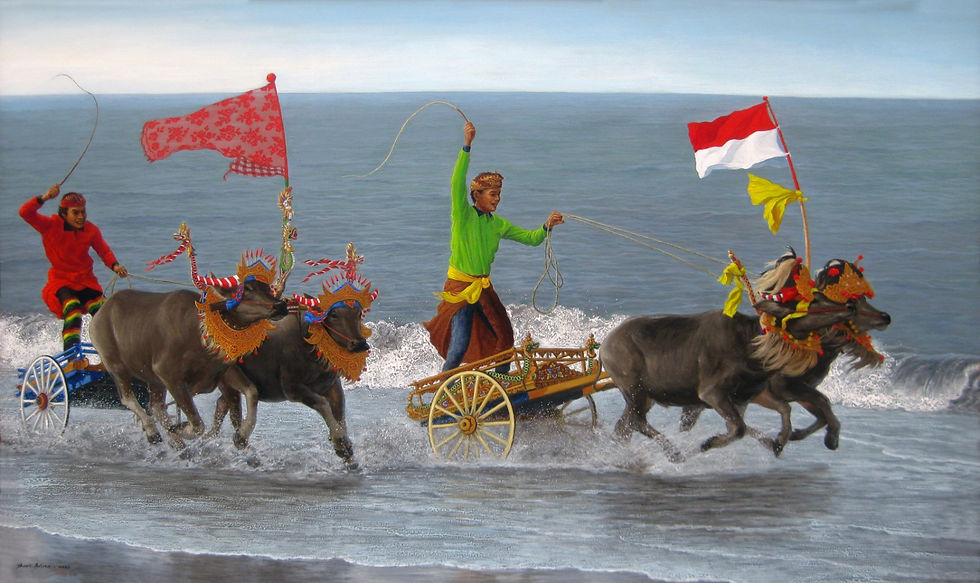
Other paintings depict daily Balinese life with great sensitivity. Women carry out daily life, one elder with a woven bamboo basket on her head, cycling through a divinely incandescent light filtering through the trees, another wearing a traditional wide-brimmed wooden Balinese hat (caping) as she tends to her geese-flock, swathed in the golden light of dawn. Others like Makepung (The Buffalo race tradition at Jembrana) (2025) surge with kinetic ceremonial intensity, as decorated buffalo charge through the surf beneath streaming flags, their riders poised in acts of balance and command for the traditional Makepung water buffalo race.
Antara's well-honed artistic practice and fluid technique paint Balinese daily life as deeply immersed with nature and a ceremonial heartbeat that is rare in the world, to be so cherished. That he was nurtured into the wider world by Hendra Hadiprana, known affectionately as Oom Henk, feels apt. The influential Indonesian collector and patron gave Antara his first solo exhibition at Hadiprana Gallery in 2000, the first dedicated commercial art gallery in Indonesia, and stayed close across decades through careful critique, commissions and continued exhibition. It is a relationship that mirrors something of the values Antara has spent his life painting: sustained devotion, given freely, across time. The gallery has carried that same spirit since its founding, now guided by Hadiprana's daughter, Sekaraya Hadiprana. To witness artistic support renewed with such care across generations is to understand that in Bali, the act of tending – to the sea, to the land, to one another – is never incidental. It is perhaps the most traditional practice of them all.
Wayan Bawa Antara is represented by Hadiprana Gallery, Indonesia.
For further enquiries: info.hadipranagallery@gmail.com / Instagram

Budi Agung Kuswara
Same sun, new light
The artists we have met so far each carry tradition forward on their own terms. But what they carry it into is a Bali under considerable pressure from mass tourism. For many families tourism means wages, schooling and opportunity; in 2025 alone, $10.1 billion was spent on Balinese land. But it also carries a cultural risk in the way markets reward what can be easily packaged, compressing complex practices into exportable icons. As Budi Agung Kuswara (b. 1982) points out, this can also slow the development of contemporary art among Balinese artists, because traditional art brings money and security.

Kuswara knows this reductive gaze from the inside. Born to Balinese–Javanese parents, he was raised in Sanur, East Bali, selling souvenirs to tourists on the beach. Sanur itself is a shoreline of arrivals. Tourists have arrived in droves since the 1930's when Belgian painter A.J. Le Mayeur popularised it with his picturesque landscapes. It is also where the Japanese landed in 1942, prising control from the Dutch following centuries of colonial rule. The community has endured wave after wave of external interest, commerce and occupation – different regimes of looking and taking, washed up on the same shore.
In Tiba Anak Cucu (2025), Kuswara returns to this tension using satire and symbolism to unravel the fantasy. He gives afterlives to colonial-era photographs of unnamed Balinese women, whom he first explored in Anonymous Ancestors (2019). Using cyanotype, a sun-print process, Kuswara develops the images into vivid tableaux where eras collide.
In Between Archive and Bloodline (2025), a young woman waves from the open back of turquoise 1950s Chevy, lacquered into Louboutins, fishnets and a mustard pin-up dress. A lace curtain frames the moment like a just-married departure, and Kuswara lets us see through the veil. The boot gapes open; she jostles amongst the luggage. Sacred cargo spills into travel logic: a gilded Rama–Hanuman figure knocks against a chipped bodhisattva head; bird-of-paradise flowers are severed from their roots and replanted in a kitsch blue-and-white porcelain vase, itself a migrant object shaped by centuries of imitation and desire. A framed portrait of a Balinese man slips out of the boot; he will be left behind. Climbing into the car are spirits; they toss their halos upwards, coalescing in a coin-bright constellation where stars might once have guided.
For all its layering of grief and tension, there is something exquisitely soothing about Kuswara's signature blues, developed through cyanotype printing. The process is driven entirely by light: sunlight acts on the surface directly, setting off the chemical reaction that produces the image. In Balinese cosmology, the sun carries sacred charge over human eternity, and Kuswara returns that light to the ancestors. If tourism, at times, teaches Bali to perform itself, Kuswara's work imbues a deeper counter-narrative – an ancient culture that preserves and develops, again and again, under the same eternal light.
Budi Agung Kuswara is represented by Mizuma Gallery, Japan & Singapore.
Check out Ketemu Project, a socially conscious collective founded by Kuswara and fellow Indonesian artists

Jemana Murti
Ghosts of the future

Kuswara's work asks what happens to tradition when the outside world decides what it should look like. Jemana Murti (b. 1999) asks a sharper version of the same question: what happens when the outside world is a machine? In 2026, where technology is advancing at extraordinary speed, tradition has a new force with which to contend. Tradition is, in its nature, human-made. So how might technology, built from global economies driven by speed and revenue, interact with centuries of soulful evolution and stewardship, passed generation to generation?
“What if the Balinese no longer honoured their responsibility as traditional custodians maintaining their culture? What would happen if we bestowed this obligation upon machines?”
– Jemana Murti

Murti tests this directly. He feeds text prompts about Balinese iconography and craftsmanship into AI image generators, converts the outputs to 3D models, then prints them in bioplastic filament derived from cassava, sugar cane and corn starch. The materials carry pointed tension – cassava, sugar cane, corn starch are the island's own crops, grown in Balinese soil, tended by Balinese hands for centuries, nourishing bodies and sustaining life. Extruded into bioplastic, they become inert forms that will never grow, never require care, cannot nourish. The parallel with tradition runs through the whole work.
Murti's artistic language is deeply local to Balinese culture: Bedogols (temple guardians/dvarapala), Nāgas (sacred serpent statues), Barong (lion protective spirits) and many more. In Future Relic: Glitch (2023), a bedogol crouches heavy on its plinth, thick paws gripping the base, haunches tensed. The form carries presence, with a mane flowing down in ridges, sharp teeth snarling with protective force. It is very close to a real bedogol statue.
Then the cobalt void cuts through the mirage, smooth and synthetic where ribs and spine should be, as though the file incompletely loaded and filled the gap with electric blue. Handpainted by Murti, the paint is luminous, pushing the entire form into twilight — neither fully present nor entirely absent. An industrial relic whose glowing core reminds us of the spiritual force the bedogol represents, before it became an eroded, digitally generated shell. The electric blue void holds the answer in suspension. Murti's guardians prove it by glowing in the twilight between what technology can reproduce and what only a human life, lived in full accountability to its ancestors, can hold.
Jemana Murti is represented by Gajah Gallery, Singapore, Jakarta, Yogyakarta.

Conclusion

Tradition is a hefty word. It implies weight, obligation, the long shadow of what came before. But what these six artists reveal, collectively, is something both more intimate and more demanding: tradition is not a monument you stand before but a threshold you keep crossing, every day, with your full attention.
Sasmita and Muriati remind us that Kamasan painting was a technology for making the sacred legible, for holding a community inside a shared vision of the cosmos, and it remains that, so long as someone takes it seriously enough to test it against the present. In Armika's hands, even a kite sent skyward in prayer carries centuries of structural intelligence in its frame. Antara's single woman poised at the water's edge contains every woman who ever stood there before her. Kuswara returns colonial light to the people it was taken from – and in that act of restitution, claims it as sovereignty. And Murti draws the line. A machine can read the archive, absorb the iconography, reproduce the form. But it has no elders to honour, no life shaped by ceremony, no community to be answerable to. It will always be a ghost of the real deal. Some things cannot be outsourced at all.
What runs through all of it is care – specific, embodied, accountable care, the kind passed between a priestess and her student, a father and his daughter, a collector and the artist he believed in. Every morning across Bali, before the day begins, someone kneels to place a small woven basket of flowers and rice and smoke at a threshold to offer back. These artists do the same. In a place under sustained pressure to perform its own culture back to an outside world, these artists kneel at the threshold of what they have inherited and make their offering, in full faith that act of art-making is presence with past, present and future.