10 Top Artists to Watch from Collect 2026
- Feb 26
- 11 min read
Updated: Mar 2
The highly-anticipated 22nd edition of Collect returns to Somerset House from 27 February to 1 March 2026. Presented by the Crafts Council, the fair is a leading international platform for contemporary, museum-quality craft and design, attracting the world’s most influential galleries and collectors.
Before doors opened to the public, a curator from Artelier Art Consultancy & Advisory received an exclusive invitation to the preview to personally identify who they thought were the best artists to watch in 2026.
Chapters:
Artists

Introduction to Collect 2026
What is Collect 2026?
Collect 2026 is a leading international fair for contemporary craft and design, bringing together work by more than 300 living emerging and established artists from at least 10 countries around the world. The fair pushes the boundaries of traditional craft techniques across a wide variety of materials and disciplines, including ceramics, glass, lacquer, furniture, jewellery, metalwork, wood, textiles and paper. Hosted in Somerset House in London, 80% of the works on show have been made in the past five years, with many created especially for the fair.
Collect's Theme of the Year: Lacquer
A medium set to feature strongly at Collect 2026 is lacquer, a centuries-old process in which multiple layers of sap from the lacquer tree are applied to a surface to produce a durable, glossy, and often highly decorative finish. Leading galleries, such as Mono Art (Tokyo), WAJOY (Kanazawa), White Conduit Projects (London), and The Gallery by SOIL (Hong Kong), will present artists who have mastered the traditional technique and expanded its possibilities through new forms, textures, and approaches.
Collect 2026 & Artelier
Proud to be welcomed by Collect, Artelier was delighted to take part in a fair that reflects our commitment to responsible artistry and the future of craft. With over 20 years of international experience, we champion emerging and established artists — locally and globally — who push their materials further while honouring heritage techniques. By promoting artists who keep traditional mediums alive and relevant, we help safeguard invaluable cultural techniques while shaping a positive legacy for future generations.
"Emerging names will be positioned alongside established masters, showing the importance of sustaining and evolving traditions and heritage across generations."
-Collect 2026 under the new leadership of Fair Director TF Chan



The Craft Movement: A Brief History
For centuries in Western art history, craft, including ceramics, textiles, woodwork, glass, and metal, was treated as separate from “fine art.” It was often tied to domestic labour and seen as a way to make useful or decorative objects, rather than something 'intellectual' or 'conceptual'. Painting and sculpture, on the other hand, were treated as culturally prestigious and intellectually superior, with appreciation and access largely reserved for the privileged few.
These beliefs were also shaped by gender and class bias. Much craft work was done by women or by working-class and rural communities, and was therefore undervalued and dismissed as domestic or practical labour, rather than recognised for its skill, creativity, or cultural significance.
In the late 19th and early 20th centuries, the Arts and Crafts movement pushed back against these ideas. It began in Britain as a response to industrialisation and mass production, calling for a return to hand making, quality materials, and the idea that useful objects could also be beautiful. By treating ceramics, textiles, metalwork, and other crafts as serious creative work, the movement helped shape what we now see as contemporary craft, where the lines between art, design, and function are far less rigid, and skill, process, and experimentation are central.

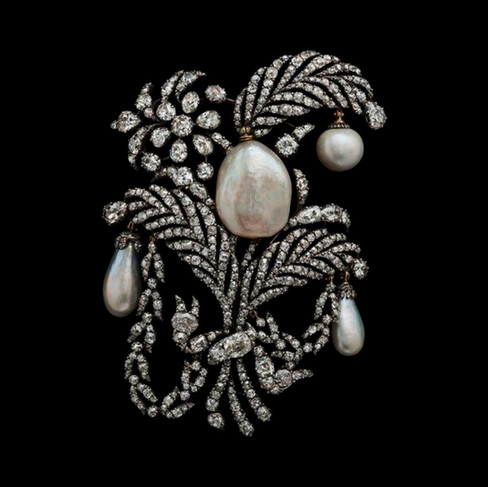


Parallels can be found in an 18th-century pearl and diamond brooch from the V&A, alongside Laura Ngyou’s Shen Ring (2025). Both pieces are crafted in silver, gold, and diamond. Far left © V&A. Far right © Laura Ngyou, Shen Ring (2025). Photo: Robert Culverhouse. Courtesy of Contemporary Applied Arts
Artists to Watch in 2026
a. Ken Noguchi
Japan

Ken Noguchi, born in 1982, is a Japanese artist who combines cotton cords with the traditional craft of urushi lacquer. Using cotton ropes wound around custom molds as a base, he builds each piece layer by layer, applying urushi lacquer sometimes with hemp cloth to manage moisture and speed drying. This process produces surfaces that are smooth, strong, and richly textured. By blending centuries-old lacquer techniques with contemporary experimentation, Noguchi creates black and red sculptures and vessels that showcase flowing curves, tactile surfaces, and layered depth.
His work has been exhibited internationally in New York, Germany, Hong Kong, and Japan, and is held in permanent public collections in Japan and Germany.
At Collect 2026, you can visit his work at stall E14 in the East Wing which is represented by WAJOY.
"Emerging as if from a land of plenty, his black and red sculptures rise like enchanted mountains."





b. Yoshihiko Murata
Japan

Yoshihiko Murata is a Japanese lacquer artist whose practice blends traditional urushi techniques with contemporary forms. Working in solid maple, he carves and bends each piece into fluid lines before applying more than twenty layers of lacquer, meticulously dried and polished over several months to achieve luminous, seamless surfaces.
His work has been exhibited widely in Japan, Italy, Germany, and the United States, and is held in the collection of the Minneapolis Institute of Art.
At Collect 2026, you can visit his work at stall W16 in the West Wing which is represented by The Gallery by SOIL.
"I seem to find lovely lines in all of nature...the flight of birds...the changes in a plant as it grows....the ridge lines of mountain."


c. Sumakshi Singh
India

Sumakshi Singh is a master of threadwork, textiles, sculpture, installation, painting, video, and performance, with a particular focus on embroidery as a structural medium. She combines techniques such as Indian braiding, lacemaking, and metallic zari stitching on water-soluble fabric, which, once dissolved, leaves behind delicate, suspended forms that translate architectural and spatial details into intricate three-dimensional structures. Her practice highlights precision, manual labour, and material innovation, creating ethereal, meticulously crafted works where thread itself becomes both medium and structure.
Her works have been presented in over 20 solo and 100 curated, group gallery and museum exhibitions in Australia, India, U.K., China, Korea, USA, Canada, France, Italy, Serbia and Switzerland.
At Collect 2026, you can visit her work at stall W1A which is represented by LOEWE Foundation.
"The weightless architecture of the thread structures, suspended in space, mirrored the fragmentary nature of memory and the lingering presence of what has been lost, dissolved or transformed.”
Sumakshi Singh in conversation with Architectural Digest Middle East, 2025


d. Kamilah Ahmed
UK & Bangladesh

Kamilah Ahmed is a London-based British Bangladeshi textile artist and embroidery designer whose work blends heritage craft with contemporary experimentation. Drawing on techniques such as Jamdani weaving and Ari hook embroidery, she transforms silk, metal threads, and unconventional materials into intricate tapestries, bespoke panels, and site-specific installations.
After a decade creating couture embroidery for top fashion houses including Dior, Valentino, and Dolce & Gabbana, she is now creating commissions for prestigious institutions such as the British Council, Spinocchia Freund, and the Venice Biennale.
At Collect 2026, she will be part of Collect Open, a dedicated section of Somerset House which showcases 11 artists who are redefining the boundaries of traditional craft. You can find her in the East Wing (E8).
“I combine hand and digital processes in my embroidered textiles to celebrate heritage techniques across artistic applications. ”
-Kamilah Ahmed via Cockpit Studios


e. Zofia Sobolewska Ursic
Poland

Zofia Sobolewska Ursic is a Polish artist and designer who uses straw to bridge art with function, materials with stories, and craft with contemporary life. Viewing straw as a material rich in historical and social meaning rather than a medium of the past, she blends straw marquetry with carved wood, woven metal, and stone to create sculptural furniture, functional objects, and site-specific installations. Her work has been exhibited at Salon Art + Design, New York, NOMAD St. Moritz, and Milan Design Week 2025.
At Collect 2026, she will be part of Collect Open, a dedicated section of Somerset House which showcases 11 artists who are redefining the boundaries of traditional craft. You can find her in the East Wing (E4).
"Material remembers — straw remembers, stone remembers. Not only histories, but emotions too. And I simply try to shape them."
-Zofia Sobolewska Ursic


f.Ralph Simpson
Canada

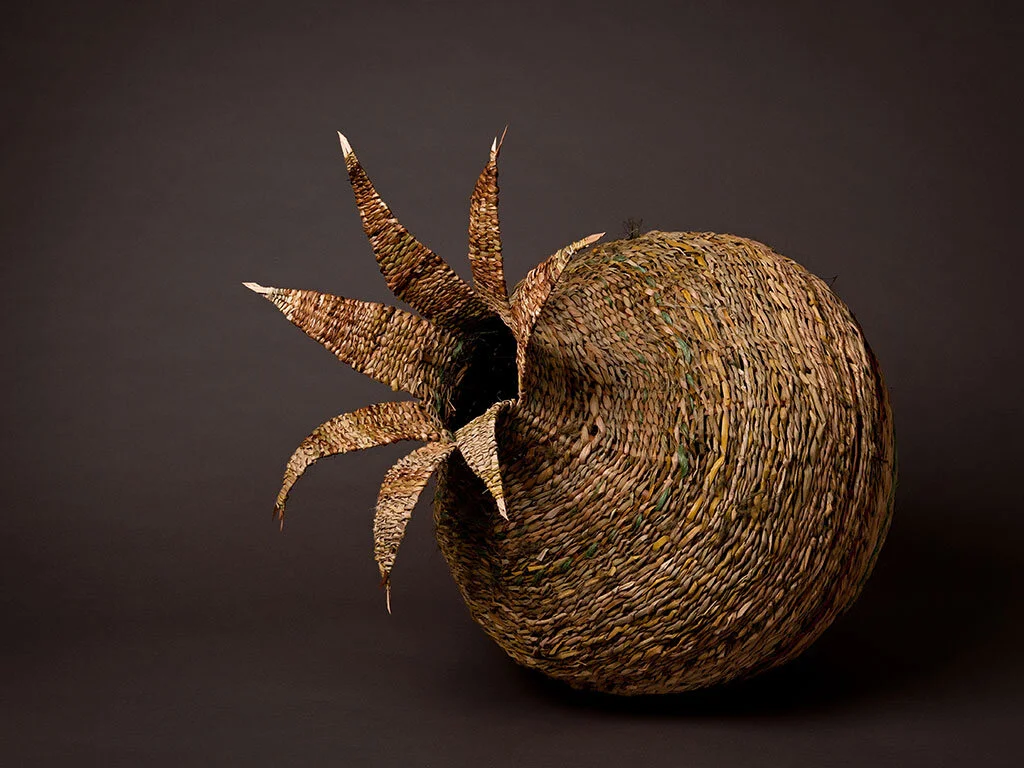
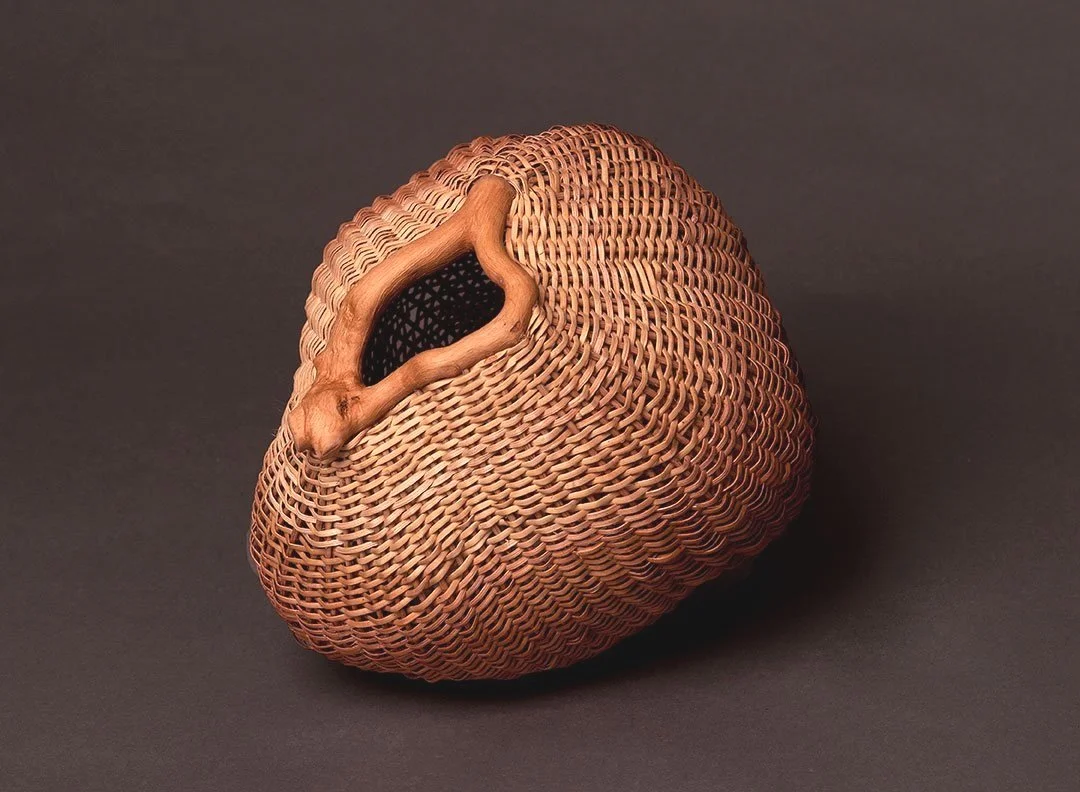
Ralph Simpson is a Canadian artist whose practice explores weaving with local indigenous plant materials. His work is strictly principled around environmental integrity and sustainability. His childhood along the Petitcodiac River in New Brunswick nurtured a deep connection to streamside plants, which led him to pursue academic studies of botany, ecology, and mycology, followed by a 35-year career with the Canadian Forest Service.
Simpson works with both woody and herbaceous fibres, including cedar, ash, maple, willow, bark, roots, sedges, rushes, cattail, and cultivated plants such as iris, lily, and papyrus, and even creates dyes from plants. He has exhibited in over 59 solo and group exhibitions across Canada, Spain, Poland, Scotland, and England.
At Collect 2026, you can visit his work at stall W1A which is represented by Craft Alliance Atlantic Foundation.
"I have an innate interest in the natural world around me, field, forest, and wetland inspires my work."
-Ralph Simpson


g. Hanna Salomonsson
Sweden

Hanna Salomonsson (or Oknytt Ceramics) is a London-based Swedish/British artist who brings the shapes and textures of Scandinavian and UK landscapes into her ceramics. She uses hand-building techniques like coiling, slab construction, sculpting, and carving to create pieces that reflect the forms of trees, forests, and mossy terrain. She also works with glazes and kiln effects, letting cracks, runs, and textures naturally shape the surface, creating tactile, atmospheric ceramics that celebrate both careful craft and the beauty of the natural world. In her latest series, she tells Artelier that she is exploring the UK’s ancient woodlands, focusing on oak and ash trees and their vital role in the local environment and history.
At Collect 2026, she will be part of Collect Open, a dedicated section of Somerset House which showcases 11 artists who are redefining the boundaries of traditional craft. You can find her in the East Wing (E10).
"My process is based on relinquishing control, and I see my pieces as an ongoing dialogue between me, the kiln and my materials."
-In Conversation with Hanna Salomonsson via Flo London, 2025




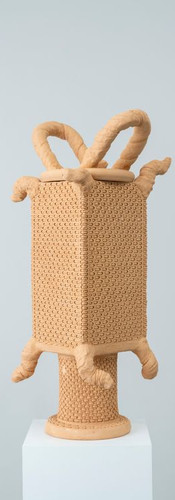
h. Kobina Adusah
Ghana

Kobina Adusah is a Ghanaian ceramicist whose practice is based on personal and ancestral history, drawing on stories, skills, and spiritual knowledge passed down through generations. Working entirely by hand, from sourcing raw clay to shaping, carving, firing, and assembly, he treats clay as a living vessel for memory. In recent series, patterns etched in the clay reference those found in his mother’s woven work as a seamstress. His work has been exhibited internationally, in Munich, Kumasi, New York, and Madrid. In 2026, he was a finalist in the Loewe Foundation Craft Prize.
At Collect 2026, you can visit his work at stall W6 in the West Wing which is represented by Gallery Fumi.
“My work [...] is rooted in the belief that the earth we walk holds memory, mystery, and story."
-Kobina Adusah in The Shape of Memory for Plural Magazine, 2025-26




i. Heike Brachlow
Germany

Heike Brachlow is a German glass artist who works with solid cast glass which plays with colour, form, and light. Equipped with a PHD and working in the Department of Ceramics and Glass at the Royal College of Art, she uses a list of eight factors (form, thickness, surface, angle, intensity, wavelength, reflection, scattering of light) to experiment with sculpture. She pours molten glass in two or more colours into moulds, allowing the movement of the hot glass to create visible flow patterns as it cools. Brachlow also developed her own kiln-based method for making coloured glass, enabling her to create a personal palette and adjust colour intensity to suit different forms.
Heike’s work is represented in public and private collections in Europe, the USA, China, Australia and India. At Collect 2026, you can visit her work at stall E25 in the East Wing which is represented by Peter Layton London Glassblowing.
"Colour is an important part of her work: the exploration of the interaction of colour, form and light in solid transparent glass during her PhD research has led her to produce her own glass colours."
-Adrian Sassoon on Heike Brachlow's technique


j. Olly Fathers
UK

Olly Fathers is a British artist who works with wood veneers, paper, card, and recycled materials to create intricate marquetry and sculptural compositions. He begins with detailed drawings and carefully selects veneers for their colour, grain, and visual impact, often highlighting burls (a large, rounded, woody growth or swelling on a tree's trunk, branches, or roots, usually caused by stress, injury, or fungus) as focal points. Each element is cut by hand with precision tools, then joined, sanded, and finished to achieve smooth, exact surfaces.
Olly’s work have been bought by private collectors in the UK, Europe, and the United States. At Collect 2026, Olly will be part of Collect Open, a dedicated section of Somerset House which showcases 11 artists who are redefining the boundaries of traditional craft. You can find him in the East Wing (E10).
"I think a lot of people enjoy that the works are made using natural materials and hand-made, which is quite a nice contrast from the fast paced digital world a lot of us are surrounded by [...] it helps to bring that calming quality to the artworks."
-Olly Fathers in conversation with Cube Gallery


Be a Patron to the Craft Movement Today

Ready to enquire about sourcing art?
Artelier is a leading art consultancy and advisory, providing specialist art market research, commissioning services, and project management. Our team of art consultants delivers expertly curated art projects internationally, serving private residential, yacht, aviation, public, and corporate projects.
Additionally, Artelier can offer art investment guidance, through our specialist ‘art concierge’ service helping private collectors navigate the art world and acquire exceptional pieces to add to their investment portfolio.
Further reading:
Author & Researcher

Ella Forster
Writer: View profile
Ella holds a BA (Hons) in History & French from King's College London, complemented by a year of international study focused on History of Art at the University of Montréal, Canada.
With a portfolio spanning across Europe, Canada, and the Middle East, Ella's diverse career includes startups, galleries, museums, and interior design. At Artelier, Ella leads the marketing and editorial team with an eye for aesthetics and branding. She also manages Artelier's artist estate projects.