10 Artists to Watch in 2026 from the MENA Region (Middle East & North Africa)
Updated: Sep 2
Artelier curator Holly Freeman spotlights artists-to-watch from across the MENA region who are redefining traditions in contemporary art. In this article, Artelier reviews and celebrates a wide spectrum of mediums, ranging from film photography and innovative woven tapestries, to abstract sculptures and paintings. Reviving ancestral techniques through a distinctly modern lens, these artists merge heritage with technology and conceptual ideas, pushing artistry into new, unexpected ways.
Jump straight to a chapter or artist:

How does Artelier define an 'artist-to-watch'?
In today’s art market, an emerging artist is defined by more than just painterly skill. To get international recognition, the criteria must goes beyond technique and aesthetics; it's also about ideas and intellectual abilities. The artists in this article aren’t ones to watch just because they're getting more press; they’re shaking things up. Their work pushes back against norms and makes bold, original statements. Each artist brings depth, richness, and nuance to their ideas, creating experiences that really stay with you. It’s this ability to keep surprising and engaging audiences that makes us confident in their lines of enquiry, solidifying a career that will continue to grow in new, exciting ways.
Ella Forster
Senior Curator, Researcher & Editor

1. Hadieh Shafie
Iran

Hadieh Shafie (b. 1969, Iran) turns ink, paint, and paper into vibrant optical worlds. Her reliefs are made from hand or print-inscribed Farsi poetry which are rolled into circular and cone-shaped scrolls, transforming the recognisable visuals of text into the abstract. Through gesture, language, and rhythmic repetition, she lifts flat surfaces into dynamic, three-dimensional forms.
Hadieh Shafie’s work is held in major institutions including the Metropolitan Museum of Art in New York, the Victoria & Albert Museum in London, and the Farjam Collection in Dubai. She was shortlisted for the 2011 Jameel Prize at the V&A, an international award recognising contemporary artists inspired by Islamic art and design. In 2017, she was nominated for Anonymous Was a Woman, a U.S. award that supports and celebrates women artists over 40, helping to foster their continued artistic growth. In 2024, she completed the London-based Delfina residency. Currently, she has a solo exhibition with 1301 SW in Sydney; we expect her work to make exciting progress in the upcoming year.
Words are an energetic charge, colour is emotion, and repetition is a kind of spiritual practice.
Hadieh Shafie in conversation with The Columbus Museum for her exhibition Beautiful Words 2025-26
© 1301 SW © 1301 SW © 1301 SW

2. Nima Nabavi
Iran
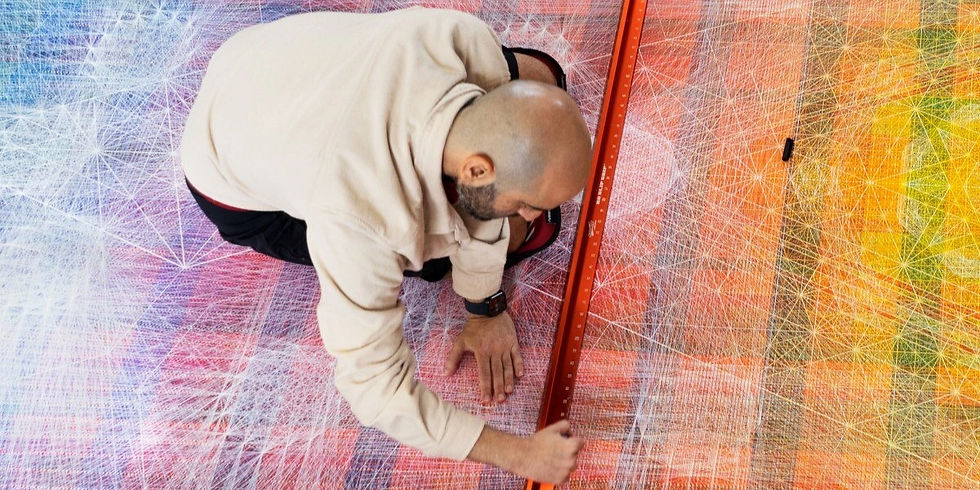
Nima Nabavi (b. 1978, Tehran; raised in the UAE) has an eye for pattern and precision and takes inspiration from his Persian artistic heritage, notably his grandfather, who was also a master of geometric art. He transforms Middle Eastern traditions into intricate tessellations, grid-based symmetry, and abstract geometric forms, blending hand-drawn detail with technology, including architectural pen-plotters, to create visually hypnotic, mathematically precise works.
His work is held in major collections such as the Anderson Museum of Contemporary Art, Deutsche Bank in Berlin, and the Jameel Arts Centre in Dubai. He has exhibited internationally in cities including Berlin, New York, and Jeddah. Recent projects include the digital façade Signal (2025) at the Jameel Arts Centre and the solo show Sunrise at the Vortex at The Third Line, Dubai.
The intense repetitions and strict parameters demand a sort of self-imposed brute force trance state to power through and complete. So there are a lot of meditative elements, but I don’t want it to sound like I’m constantly in a blissful state while I work. There is definitely a lot of frustration and challenge too.
Nima Nabavi on artistic discipline in an interview with Verse in 2022

3. Hayv Kahraman
Iraq

Hayv Kahraman (b. 1981, Baghdad, Iraq) is an Iraqi artist of Kurdish descent based in Los Angeles. Drawing on her experience of fleeing Baghdad at age 11, she explores the body, memory, diaspora, and identity. Her work often uses her own form, or a collective feminine figure, to tell stories of displacement and belonging. Influenced by Persian miniatures, Islamic manuscripts, Japanese woodblock prints, Renaissance painting, calligraphy, and textiles, she works across painting, sculpture, installation, performance, and 3D body scans. Through these forms, Kahraman addresses colonial histories, gender norms, and cultural stereotypes, giving voice to marginalised diasporic women and examining how trauma and migration shape identity and memory.
Hayv Kahraman’s work is held in major institutions and galleries worldwide, including Jack Shainman Gallery in New York, The Third Line in Dubai, LACMA in Los Angeles, the British Museum in London, Barjeel Art Foundation in Sharjah and the Rubell Museum in Miami. In the past two years, she has presented two solo exhibitions and participated in ten group shows across the US, UK, and Hawaii.
I’m an artist who’s very controlled in her work. I never start a painting without knowing exactly what it’s going to be. There’s a lot of prep work in my process. I attribute that to having survived and grown up through so many traumatic experiences: I’m a survivor of war and a survivor of domestic violence.
Hayv Kahraman in conversation with Bomb Magazine in 2024
4. Jason Seife
Syria / Cuba

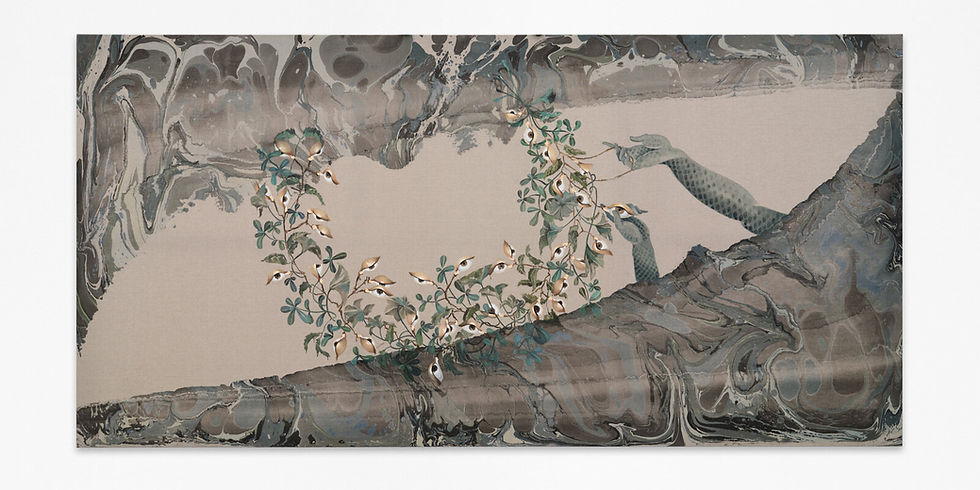
Jason Seife (b. 1989, Miami, USA) is a Cuban-Syrian artist working from his hometown of Miami. He reinterprets the Middle Eastern tradition of tapestry and carpet making for the contemporary moment: some of his works mirror the rich, ornate patterns of classic textiles, while others are deliberately “aged,” critiquing modern society’s fading appreciation for this art form. Building on his heritage, Seife studied the history, symbolism, and patterns of traditional Persian carpets and traveled to Syria, his father’s homeland, as well as to Iran, Turkey, and Morocco, seeking inspiration for his work.
Seife’s work can be found in major public and private collections around the world, with a presence in leading institutions including the Fort Wayne Museum of Art in the US, Mosaic Art Foundation in Istanbul, Contemporary Art Platform in Kuwait, and Leila Heller Gallery in Dubai.
There’s very little support for products like handmade carpets, weaving, tableware or ceramics now in some of the Middle Eastern countries [...] What happens when this generation that has learned this trait stops making them? Are we only going to be able to see these [works] in museums?
Jason Seife on blending contemporary mediums with traditional art forms, in discussion with Harper's Bazaar in 2021

5. Sara Naim
Syria

Sara Naim (b. 1987, London, UK) is of Syrian descent and is based between London and Dubai. Her works are conceptual and installation-based, blending photography, sculpture, and painting to explore how language, symbols, and cultural frameworks shape meaning. She often uses technological glitches as metaphors for the limits of language, examining how we reflect and represent ourselves rather than experiencing reality directly.
Naim has earned considerable recognition across the Middle East, including a feature in Vogue Arabia’s 2019 article, “5 Arab Stars You Need to Know.” More recently, Naim was selected as one of the 15 finalists for the 2023 Taoyuan International Art Award. Over the past two years, notable highlights have included both solo and group exhibitions in Dubai, Abu Dhabi, and Taiwan.
People do love to frame you based on your background, such as me as a 'Syrian' artist. Of course, heritage and where I come from play a role in my perception and therefore the work that I make. But again, going back to this idea of the non-boundary, Syria was also part of Lebanon 80 years ago and their separation is in very recent history. When you look closer, we are all more connected than we think or assume [...] That's really the crux of my practice—describing boundaries as unfixed and elusive geopolitically to borders that define countries and people's movement.
Sara Naim in conversation with Ocula in 2023

6. Ishaq Madan
Bahrain

Ishaq Madan (b.1992, Bahrain) is a Bahraini photographer and visual artist whose work explores identity, narrative, and the quiet poetry of everyday life across Bahrain and the wider Arab world. His images blend humour, tenderness and myth to reframe how contemporary Arab stories are seen and shared in select media. He describes his photographs as “visual stories” and sees photography as “a passport to another world, where it silences all the noise of reality.”
He has been featured in the Sharjah Art Foundation, Gulf Photo Plus, the 2019 Paris Biennale, and the Bahrain Annual Fine Arts Exhibition. He has also been commissioned for various projects and campaigns by major clients, including McDonald’s, Harper’s Bazaar Arabia, and KPMG.
His works has also been featured by MoMA in New York, Misk Art Institute, and Bahrain Authority for Culture & Antiquities.
To a degree it is also therapeutic, specifically street photography, as it allows me to take a step back and observe the world, allowing me to appreciate the mundane and my existence in this temporary plane.
Ishaq Madan in an interview with Fact Magazine in 2025

7. Lalla Essaydi
Morocco

Lalla Essaydi (b. 1956, Marrakesh, Morocco) is a contemporary Moroccan photographer and painter whose work explores the representation of Arabic female identity. Drawing on the visual language of 19th-century Orientalist painting, she reclaims and subverts these historical depictions of Arab women. Essaydi often hand-paints Arabic calligraphy in henna onto fabric, bodies, and walls, creating layered, immersive compositions. Her photographs critically examine the social, cultural, and power structures imposed on the Arab female body, highlighting the tension between tradition, gender, and contemporary identity.
Since 2001, Essaydi has presented more than 50 solo exhibitions, and her work is held in over 60 public collections, including the British National Museum in London, members of the UAE royal families, and the Louvre in Paris.
My work introduces alternative, challenging perspectives on canonical 19th-century Orientalist paintings [...] At the same time, I also celebrate the cultural richness of Morocco, the Middle East and North African countries. Although I tend to think of my work as, first and foremost, being about the experience of women, I would say that these elements are also significant.
Lalla Essaydi on her approach in an interview with Global Voices in 2020

8. Mounir Fatmi
Morocco

Mounir Fatmi (b. 1970, Tangier, Morocco) creates visually striking, multimedia works that act as “aesthetic traps,” using beauty to draw viewers in before revealing deeper political, social, and philosophical questions. Working at the crossroads of Western and Eastern cultures, he challenges fixed ideologies and embraces crisis, failure, and experimentation as creative tools. Fatmi often works with everyday or obsolete technologies, such as cables, typewriters, VHS tapes, books, treating them like elements of an “experimental archaeology” to explore power, communication, memory, and the contradictions of contemporary society. Across all his work, the viewer remains central: his installations invite participation, provoke reactions, and spark dialogue, turning art into a direct exchange between artist and audience.
Over the past two years, Mounir Fatmi has maintained a remarkably active exhibition schedule, presenting work at video festivals and screenings in France and Sweden, participating in art fairs across the GCC region, Europe, and the United States, appearing in eleven group exhibitions in 2025 alone, and exhibiting a solo show in Tokyo.
I have always believed that artworks can have a political or religious or societal meaning but before all else, a work of art must be aesthetically pleasing. That is what the artist uses to [...] attract an audience to their work and allows for communication.
Mounir Fatmi in Where Art Meets Technology, an interview with The Marqaz Review in 2024

9. Radhika Khimji
Oman

Radhika Khimji (b. 1979, Muscat, Oman) is an Omani artist who lives and works between Oman and London. Over the past two years, she has received critical acclaim through both group and solo exhibitions in India, London, Oman, and the UAE. In 2022, she was among the artists featured in Oman’s first-ever pavilion at the Venice Biennale.
Radhika Khimji’s art blends many forms, including painting, drawing, collage, embroidery, and sculpture. This blend means they don't fit neatly into any single category. By resisting labels, her work ends up highlighting how identities themselves are often limiting. She uses the physical process of making art to break down and challenge fixed ideas about identity. By questioning how things are named or classified, she creates new meanings for objects and separates them from their usual associations.
There is a subtle push and pull between whether the object is a painting, a drawing or a sculpture, whether its identity is under question. There is always this need to evade the trap of identification.
Radhika Khimji describing her approach in an interview with South South Art in 2022

10. Eman Ali
Oman

Eman Ali (b. 1986, Muscat, Oman) is an Omani-Bahraini visual artist working across the Middle East and Africa. Her work looks at power and identity, often playing with light and using AI in her creative process. She mixes reality and imagination in her images, creating a space where memory, personal stories, and cultural history come together.
Over the years, Eman Ali has gained recognition for her photography, being shortlisted for awards like the Foam Paul Huf Award, the European Photo Award, and the Taylor Wessing Photographic Portrait Prize. More recently, she was nominated for the C/O Berlin Talent Award (2024)and shortlisted for the PRIX BMW ART MAKERS Award (2023). In 2020, she won the Single Image prize at the British Journal of Photography’s Female in Focus Awards. She was also commissioned to create a photographic essay for Bahrain’s national pavilion, Fever Shape (2025), which won the Golden Lion at the 2025 Venice Architecture Biennale. Her work has been shown in fairs, biennales, and exhibitions across Africa, Asia, Europe, and the Americas.
Curiosity is absolutely essential. It’s very liberating not having everything planned out and letting the work surprise you along the way.
Eman Ali on embracing the unexpected in an interview with Art Momentum, January 2025

Ready to invest in artists from the MENA region?

Artelier is your partner in navigating the world of emerging Middle Eastern artists.
Our Art Concierge service, powered by seasoned art consultants, excels in identifying budding talents and meticulously curating collections tailored to your investment objectives. As a turn-key art consultancy, we work diligently to curate a collection from research to our framing service and installation.
For further insights, delve into our free, comprehensive industry guide, and feel free to reach out for personalised guidance on your investment journey.
Keep Informed about the Art World

Art is in our DNA. Our team, founded on professional and academic expertise in the arts, is committed to contextualising our practice within the broader art market. Want to check out our other published articles?
We deliver forward-thinking insights and strategies for today’s art collectors, scrutinising emerging trends to instead advocate original ideas.
Author & Researcher

Holly Freeman
Researcher: View profile
With a BA (Hons) in Art History & Curation, Holly is interested in strategic investment from the contemporary art scene, from emerging graduate artists to blue-chip masters.

Ella Forster
Writer: View profile
With a BA (Hons) in History and French and three years of writing experience for online magazines and museums, Ella is a skilled researcher in critical art theory with a strong commitment to making art education accessible to everyone.