top of page

Artelier Curation: Glass Installation at General Motors, Detroit USA

  • Jun 23, 2025
  • 2 min read

As public and landscape art consultants, Artelier has specialist expertise in developing art strategies and commissioning bespoke installations and sculptures. Our projects have spanned varied public realm spaces, including: mixed use developments, corporate contexts, public parks, sculpture gardens, residential developments, landscapes and temporary installations.


An upward-looking shot captures the architectural grandeur of the Renaissance Center in Detroit, Michigan, against a backdrop of a subtly overcast sky. The complex consists of a cluster of skyscrapers, each with a unique design, yet harmoniously connected.

The centerpiece is a cylindrical glass tower, its surface reflecting the surrounding buildings and sky. At the pinnacle of this tower, the "GM" logo is prominently displayed, identifying it as the headquarters of General Motors. The tower's sleek and smooth façade contrasts with the angularity of the surrounding structures.

Flanking the central tower are two rectangular skyscrapers, each with a blend of dark, tinted windows and light-colored architectural elements. These buildings share a similar design, featuring rounded corner columns that add a touch of sophistication to their otherwise linear structures. The windows of these towers reflect ambient light, contributing to the overall luminosity of the scene.

The ensemble of buildings is captured from a low angle, emphasizing their height and imposing presence. The overcast sky provides a soft, diffused light that brings out the subtle textures and details of the architectural surfaces. The image showcases the complex's modern aesthetic, while also highlighting its place in the Detroit skyline.


Art Makes the Architecture


Collaborating with artist Danny Lane, monumental glass was engineered into the architecture. A part of the integral fabric of the building, the work becomes immersive as the public moves through sheets of fluid glass.


A low-angle view shows a large, abstract structure of vertical teal-green thin bars beneath a white ceiling with long, white geometric forms. The piece runs horizontally and appears to take the form of a large wave. A curving silver-colored pole runs horizontally along the structure about one-quarter of the way down from the top. The ceiling above the structure is uneven and bulbous; shadows cast upon it by lighting fixtures give the white surface a streaked appearance. Light reflects off the vertical bars of the structure, which are set against a background of industrial gray girders and supports. At the bottom-center of the image is a window and a wall from which the bars descend.

© Danny Lane, represented by Artelier


A Feat of Engineering


To achieve this feat, the artists' studio and curators worked with leading engineers during the work's construction. The sculptures pushed the possibilities of glass art to its limit, re-imagining it as a structural component of the space.


Three men work at an installation in an architecture that has a wall of thin, stacked glass held in place by a frame, giving it a textural appearance.

The man at the far left is wearing blue jeans and a black long-sleeved shirt holding a piece of the glass; he also has a white hardhat on his head. The second man is wearing a similar outfit to the first man, including the white hardhat. He is standing on part of the structure and helping to hold the top piece of glass with both hands. The third man is in the foreground facing away from the viewer. He has on a black shirt, black cap and black pants. On the back of his shirt, the word "CHRSTY" is visible.

A portion of the wall has already been assembled. The assembled part gives a textural appearance because of the thinness of each pane of blue-ish glass. Through the glass, a spiral staircase is seen. The wall stretches diagonally from the bottom right upward and to the left, and nearly reaches the ceiling.

The architecture shows a white wall in the back left with circular columns. Three recessed lights are also seen in the ceiling.

The lighting is bright.


© Danny Lane, represented by Artelier


Carving Glass


Countless sheets of stacked glass are carved following a complex structural design. In many ways, it is a traditional process of crafting the surface of glass – an artist's workshop process, that requires hours of cutting, carving and polishing.
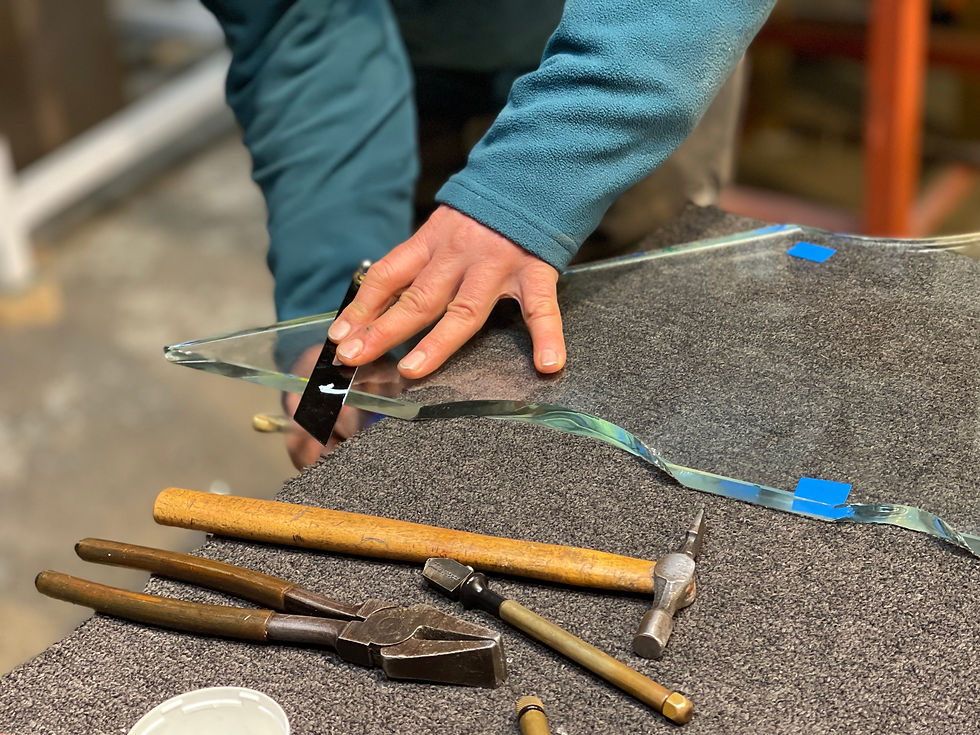


A person in a blue fleece is carefully working on a piece of glass on a carpeted surface. The glass has an irregular shape and is secured in a few places with blue tape. A black glass cutter is in use, held in their hand.

Several tools are visible on the carpet, including a wooden-handled hammer with a metal head, a pair of nipping pliers with brown handles and a dark metal head, and another thin brass tool with a long cylinder body and a brass tip. A small white saucer is visible. The scene is well-lit with overhead lighting, suggesting a workshop or studio environment.

© Danny Lane, represented by Artelier


Sculpting with Light


Carving becomes a creative statement, as the prismatic qualities of glass are revealed in a spectrum of dazzling colours. The glass sculptures were curated with sensitivity to light sources, bringing them to life for the public.


In a museum, an abstract, sculptural, glass room divider is illuminated beneath a spotlight.

The divider has two panels on a single elongated base. They're separated by a narrow vertical gap. Both are made from layers of horizontal sheets of aquamarine glass and the sheets are thick enough to create the appearance of horizontal lines running parallel across the surface. The inner edges of the panels have been distressed and carved into sinuous, undulating shapes, resembling a water feature. The edges of the glass refract and bend light. The structure is set upon a flat, dark rectangular base that is almost touching the left, right, and back edges of the panels.

The divider separates the image into two sections. On the left is a pale grey wall, and suspended on it is another glass sculpture that is green and shaped like a figure. The right of the image shows the same pale wall and an industrial metal ceiling light.

A spotlight has been placed in front of the divider and is shining up onto the sculpture.

© Danny Lane, represented by Artelier


Our Public Art Services
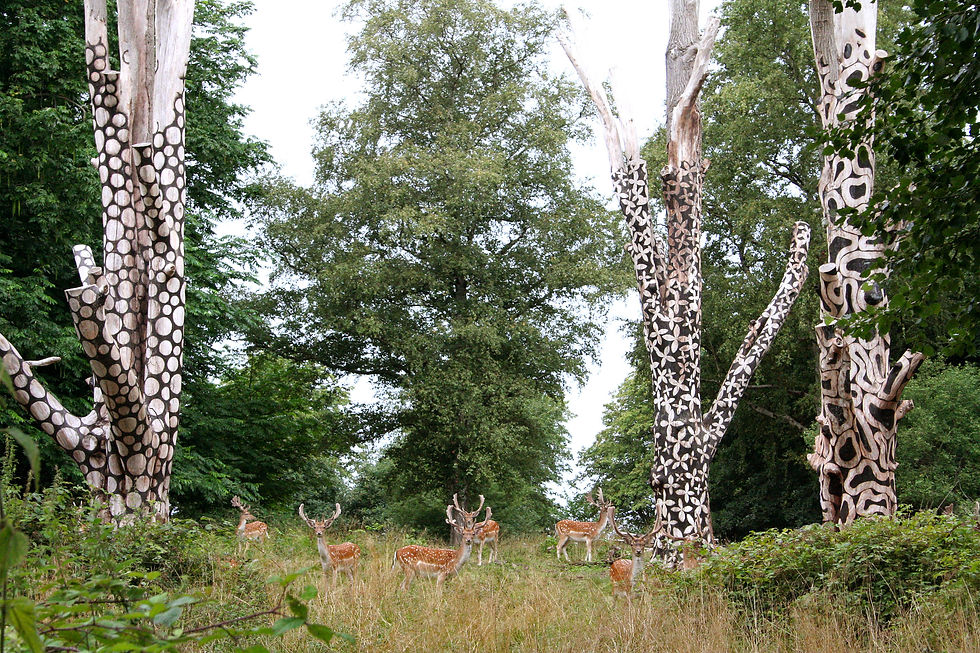

In a high angle, medium shot, a herd of spotted deer gathers at the foot of three dead but elaborately decorated trees in a grassy field on a cloudy, sunny day. The trees are spaced across the image, with one on the left and two on the right. There are 7 deer in the field, all looking at different parts of the landscape around them. Two of the deer are looking to the left, one is looking to the right, and the remaining deer are looking towards the viewer. All of the trees are dead, but each of the standing trees is decorated with black paint to create artistic, geometric patterns. The pattern on the left tree appears to be black dots surrounded by the natural white of the bark. The middle tree is covered in flower-shaped designs, and the right tree is decorated with looping black shapes. Behind the field in the background is a forest composed of many green trees.
Public Art Commission in a National Trust Forest © Stuart Ian Frost

With specialist expertise in art strategy & large-scale artwork commissions, Artelier delivers a turnkey consultancy service for public art, landscape & garden projects


Further Reading


Want to explore other areas of our work? Read one of our articles or dive straight back into a project:


Comments
Share Your ThoughtsBe the first to write a comment.

Offices

United Kingdom

154 Cheltenham Road, Bristol, BS6 5RL, UK

Barcelona 

Rambla de Catalunya 38, 8º, 1ª, 08007 Barcelona, Spain

Client Offices - Appointment Only

London

64 Grosvenor Street

Mayfair, UK

Dubai 

739 Sheikh Zayed Road

Dubai, United Arab Emirates

Hong Kong

Opening Soon

Spring 2026

Contact Us

Linkedin Logo on Artelier website
© Copyright

© Artelier 2026

bottom of page