The Art of 'Komorebi': Light, Reflection & the Unstable Image
Updated: Jun 29
Timed with the opening of the 61st International Art Exhibition – La Biennale di Venezia, The St. Regis Venice introduces 'Komorebi', a new contemporary art project that rethinks the hotel as a perceptual environment. The exhibition was conceived by curator Marta Cereda and developed with The St Regis Venice in collaboration with Artelier Art Consultancy. On view from May 2026 to April 2027, the exhibition deepens the hotel’s role as a cultural salon on the Grand Canal
Go straight to a chapter;

Introduction
There is a Japanese word, komorebi, used to describe sunlight filtering through the leaves of trees. The term refers less to a fixed image than to a temporary condition: light appearing only through interruption, movement, and shifting forms of visibility.
In Venice, that instability already belongs to the city itself. Reflections fracture continuously across canals and windows, façades dissolve into water and atmosphere, and interiors change appearance throughout the day according to humidity, tides, fog, and seasonal light. Conceived for The St. Regis Venice, Komorebi unfolds from these unstable, perceptual conditions.

The exhibition brings together works by Nina Carini, Gaia De Megni, Marco De Sanctis, Joan Jonas, Jure Kastelic, and Marinella Senatore. Installed throughout the hotel’s public spaces, the project approaches the building not as a neutral backdrop but as an active environment shaped by circulation, hospitality, reflection, and temporary forms of attention. Moving through the exhibition means moving through fluctuating conditions of visibility, where surfaces absorb, redirect, or disperse light rather than simply reflecting it.
Throughout history, Venice has often been described through instability and transformation. The city exists in continuous negotiation with water, humidity, tourism, seasonal rhythms, and environmental fragility. Architecture appears suspended between permanence and disappearance, while reflections constantly alter the perception of scale, depth, and orientation.

Komorebi unfolds within these conditions, allowing instability itself to become part of the exhibition’s structure. Many of the works remain deliberately exposed to atmospheric change, allowing oxidation, reflection, shadow, and atmospheric shifts to become active parts of the exhibition itself.
At The St. Regis Venice, these perceptual conditions are intensified further. Light enters the hotel unevenly through the Grand Canal-facing windows, reflecting onto polished surfaces, mirrors, marble, and glass. Public and domestic atmospheres overlap continuously. Guests move through the same spaces where artworks appear, disappear, and re-emerge according to time of day and changing illumination. The surrounding environment remains visible within the works themselves, continuously altering their appearance and perception.

The Artists
Nina Carini
Nina Carini, The Water Rises, 2026 © Tiziano Ercoli, courtesy of The St. Regis Venice. Nina Carini, The Water Rises, 2026 © Tiziano Ercoli, courtesy of The St. Regis Venice. Nina Carini, The Water Rises, 2026 © Tiziano Ercoli, courtesy of The St. Regis Venice.
Nina Carini (@ninacarini_______), The Water Rises, 2026, environmental installation, mixed media. Loan courtesy of the Artist and Berengo Studio. Photograph © Tiziano Ercoli, courtesy of The St. Regis Venice.
The exhibition opens with Nina Carini’s The Water Rises, a large-scale environmental installation developed specifically for the Long Gallery. Inspired by Venice’s lagoon ecosystems and endangered salt marshes, the work combines reflective structures, vegetal elements, Murano glass, and cast bronze and aluminium forms produced between Berengo Studio and Fonderia Battaglia in Milan. Transparent surfaces collect and scatter light across the corridor, while reflections continuously shift according to movement through the space.
The Water Rises behaves like a suspended ecosystem temporarily condensed inside the hotel. Vegetation appears partially submerged within reflective structures, while transparent glass forms seem to dissolve into the surrounding light conditions. Throughout the day, shadows and reflections continuously transform the installation’s appearance, extending the instability of the Venetian landscape into the interior architecture of the Long Gallery itself.
The mirrored ceiling of the corridor further fragments the installation into fragmented repetitions. Elements multiply across reflective surfaces, while the changing daylight of Venice alters the atmosphere of the work from morning to evening. Carini’s installation never appears fully identical from one moment to another. Instead, it exists in a condition of continuous transition, suspended between sculpture, landscape, and environmental perception.
Marco De Sanctis

Nearby, Marco De Sanctis presents a sculptural intervention derived from the Laocoön. Installed near the hotel entrance, the bronze figure appears altered by vegetal appendages resembling agave leaves, attached to the body almost like organic excrescences. Produced with a verdigris patina, the sculpture evokes an archaeological remnant and is conceived to remain exposed to humidity and rainwater, which gradually activate further oxidation across the surface over time.
Marco De Sanctis, La Pleureuse (Laocoonte), 2023 © Tiziano Ercoli, courtesy of The St. Regis Venice. Marco De Sanctis, La Pleureuse (Laocoonte), 2023 © Tiziano Ercoli, courtesy of The St. Regis Venice.
Marco De Sanctis (@marcodesanctis_), La Pleureuse (Laocoonte), 2023, bronze sculpture with copper patina, 180 × 110 × 70 cm. Loan courtesy of the Artist. Photograph © Tiziano Ercoli, courtesy of The St. Regis Venice.
Here, water is not simply represented but imagined as an active material condition within the work itself. If installed outdoors, rainwater passes through the sculpture and reaches the eye sockets, generating slow chromatic transformations. The work exists in a suspended state between classical monument and organic mutation, allowing the mythological body to appear vulnerable to the same environmental forces shaping the city around it.

De Sanctis’ intervention introduces a slower temporal dimension into the exhibition, both in this work and in the other pieces presented, particularly Crepuscolo, Vanitas, and Secret Garden. Across the artist’s practice, whether working through lost-wax bronze casting, cyanotype, or engraved copper surfaces, a central concern remains the relationship with the passing of time, which the artist attempts to crystallise. Transformation becomes embedded within the structure of the works themselves.

Gaia De Megni

Gaia De Megni’s work (in collaboration with mirai) presented in the library of The St. Regis Venice is a paper marionette that introduces a light and mutable presence into the space. Suspended and seemingly weightless, the figure inhabits the room without fully occupying it. Inspired by shadow theatre, the work takes the form of a white articulated silhouette whose movable parts suggest a continuous possibility of transformation. Its imagery derives from Brouillon pour un dictionnaire des amantesby Monique Wittig and Sande Zeig (1976), a book in which the authors construct a utopian narrative of the feminine.
Lightness becomes both material and condition, allowing the figure, which recalls the mythology of metamorphosis and the Amazons, to remain in a state of silent activation. Installed within a space dedicated to reading, silence, and reflection, the work opens a subtle field of associations where language, body, and imagination converge.
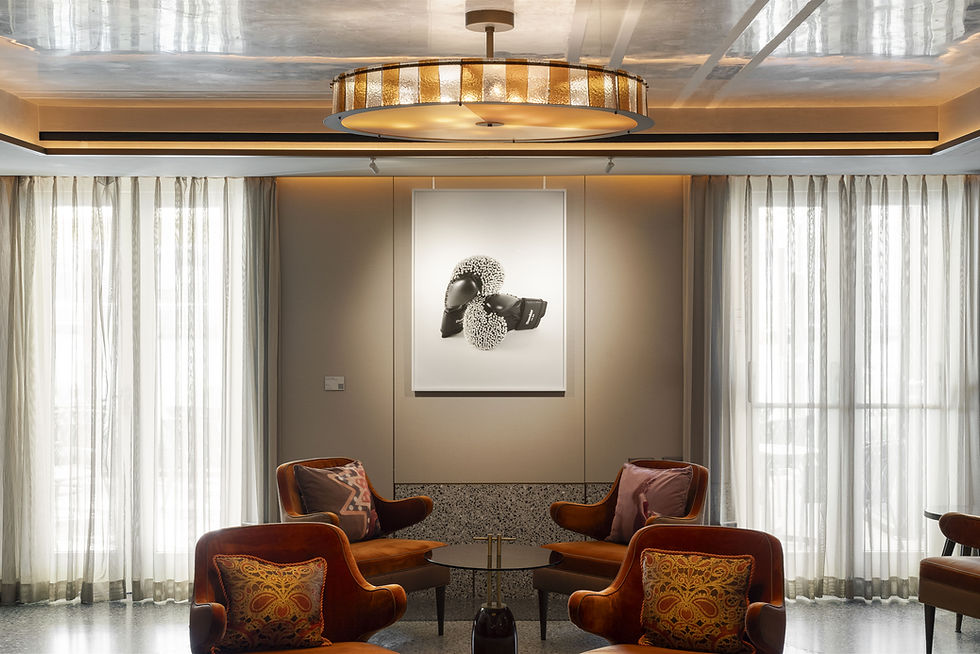
In the Arts Bar, meanwhile, the artist presents a photograph by Alessio Belloni depicting the boxing gloves used in Sunday Best, a performance in which Gaia De Megni explored the figure of the femme fatale as a central element of film noir, investigating the evocative power of voice and costume. Removed from the performative context, the props become an autonomous image. Marked by small bells, the gloves suggest a gesture that has either not yet occurred or has only just been completed, generating an ambiguous construction in which identity and role no longer fully coincide. The implied sound introduces a latent dimension, while the image concentrates attention on the relationship between body, voice, and device.
Joan Jonas

Questions of gesture, repetition, and transformation continue in Joan Jonas’s works. Across decades, Jonas has developed a visual language in which drawing, performance, storytelling, ritual, and moving image remain in continuous exchange. Within Komorebi, her presence acts as a shifting point of orientation within the exhibition. Images and gestures circulate without settling into fixed narrative form, remaining open to repetition and reinterpretation.
In dialogue with the architecture and wall decorations of The St. Regis Venice, whose patterns recall the mosaic floors of the Basilica di San Marco, Jonas’s works introduce a temporal dimension distinct from the surrounding installations. They unfold through rhythm, recurrence, and accumulation. Bird silhouettes are distributed throughout the space like a shifting constellation. Essential and repeated, these forms do not describe individuals so much as register variations of movement and gesture.

Jonas’s drawing is characterised by its ability to capture movement through minimal marks, conveying the essence of a figure through reduction and repetition. In continuity with her wider practice, where performance, video, installation, and observation of the natural world intersect, these signs function as traces of action and fragments of lived experience. Arranged like a dispersed cloud, they construct an unstable field in which figures emerge and disperse without ever settling into a definitive image.
Throughout her practice, Jonas has approached performance as a space of continuous transformation. Images move between media, gestures reappear across decades, and narratives remain deliberately open. Within Komorebi, this condition resonates strongly with Venice itself, where reflections, shadows, and atmospheric shifts continuously interrupt stable perception.
Jure Kastelic

Jure Kastelic’s works extend the exhibition’s shifting visual conditions through painterly reflections and optical ambiguity. In his acrylic paintings on jute, surfaces behave unpredictably, changing appearance according to movement, proximity, and surrounding light.
Seen within Venice, where water and glass continuously fragment the urban image into reflections, Kastelic’s works amplify this instability further. His images remain partially inaccessible and suspended in mystery, traces of a mythology the artist gradually constructs and invites the viewer to enter.
Positioned at the end of a long corridor marked by rhythmic lighting, the works seem to extend the surrounding architecture beyond its physical limits, metaphorically opening breaches within the walls of The St. Regis Venice itself. The viewer is drawn into a suspended narrative space, uncertain whether to search for orientation or remain within disorientation.
Kastelic’s practice is deeply connected to the Greek myth of Minos, Ariadne, and the Minotaur. The labyrinth recurs throughout his work not simply as symbol, but as a mental and perceptual condition. His paintings ask what kinds of tools might allow us to leave the labyrinth — or whether inhabiting it might be another form of knowledge altogether.
Marinella Senatore

With works distributed throughout the exhibition, Marinella Senatore introduces light as a shared language extending outward into the city. Suspended above the fireplace in the Arts Bar, the neon phrase I contain multitudes transforms Walt Whitman’s words into a luminous affirmation of multiplicity and coexistence. The neon extends language directly into the hotel’s social spaces, where hospitality, encounter, and circulation continuously overlap.

Marinella Senatore, Don Chisciotte, 2024 Marinella Senatore (@marinellasenatore_), Opera Opera!, 2024
Marinella Senatore (@marinellasenatore_), Don Chisciotte, 2024, and Opera Opera!, 2024, collage and gold leaf on wooden board, 50 × 70 cm each. Loan courtesy of the Artist and Mazzoleni © (above) Tiziano Ercoli, courtesy of The St. Regis Venice. © (bottom left & right) Artelier Art Consultancy
Inside the St. Regis Bar, two collages illuminate the room. Across golden surfaces, images collected over time, silhouettes of real figures, and narrative fragments converge into open compositions. Senatore constructs a theatre without depth, where the reference to Don Quixote — the errant knight of Miguel de Cervantes’s seventeenth-century novel, suspended between reality and imagination — introduces a subtle slippage between fiction and action. Senatore’s multidisciplinary practice, rooted in the performing arts, from dance to opera, condenses here into images that function less as representations than as devices for possible action. As throughout her work, meaning emerges through participation, activation, and collective presence rather than through fixed narration.

This relationship between light and collectivity expands further in Senatore’s luminous installation overlooking the Grand Canal: We rise by lifting others. Inspired by traditional southern Italian festive illuminations and temporary baroque architectures, the work remains visible both from inside and outside the hotel, projecting light directly into the city. The installation disperses the exhibition into Venice’s nocturnal landscape, where reflections continue dissolving across the water after sunset.
Berengo Studio
Glass also recurs throughout Komorebi, particularly through the exhibition’s dialogue with Berengo Studio in Murano and through works by Tony Cragg, Zheng Chongbin, and Laure Prouvost. Here, glass is approached not as a neutral or purely transparent material, but as a surface capable of retaining, scattering, and diffusing light. Reflections rarely remain stable. Transparent elements absorb shadows, mirrored surfaces fragment images, and illumination behaves less like a fixed source than like an atmospheric condition continuously shifting through the space.

Laura Prouvost, Daniella, 2024 ura Prouvost, Lotte, 2024
Laure Prouvost (@studioprouvostsocialclub_), (left & right) Daniella, 2024, glass and bronze, 102 × 47 × 53 cm, and Lotte, 2024, glass and bronze, 43 × 54 × 62 cm, (middle) Joan Jonas, Untitled, 2015, ink on paper, 29 × 39 cm. Loan courtesy of the Artist and Berengo Studio (Laure Prouvost) and the Artist and Raffaella Cortese, Milan and Albisola (Joan Jonas) © (top) Tiziano Ercoli (bottom left & right) Artelier Art Consultancy
This material instability becomes central to the exhibition as a whole. Bronze oxidises, water activates surfaces, reflections alter perception, and environmental conditions continuously reshape the visibility of the works. Atmospheric change remains continuously visible throughout the exhibition itself.
At the same time, the project reflects a longer Venetian history of light as both material and symbolic presence. From the reflections of water across palace façades to the traditions of Murano glass production, Venice has historically existed through unstable forms of visibility. The city continuously produces images that appear temporary, fragmented, and impossible to fully stabilise. Komorebi extends this condition rather than attempting to resolve it.

Conclusion
Throughout the exhibition, works emerge gradually, alter according to environmental conditions, or remain partially inaccessible depending on time of day, weather, and movement through the space. Visitors encounter the exhibition through circulation instead of following a fixed linear sequence. Perception unfolds slowly, through repetition, return, and changing conditions of light.
Komorebi moves through fluctuating perceptual states without resolving into a singular narrative. The exhibition remains deeply entangled with the instability of Venice itself, where reflections, humidity, shadows, and atmospheric transformations become inseparable from the experience of the works.
In a moment dominated by acceleration, spectacle, and overexposure, Komorebi proposes a different rhythm, shaped by slowness, attention, and unstable forms of visibility. The exhibition resists the idea of the image as something immediate or fully accessible. Instead, perception unfolds gradually, through fragments, interruptions, and temporary alignments between body, architecture, atmosphere, and light.
Venice has long existed as a city shaped by appearances that never remain fully stable. Water alters the perception of architecture, reflections dissolve spatial boundaries, and light continuously transforms surfaces into temporary images. Within Komorebi, these conditions are not simply represented but extended into the exhibition itself. The works do not attempt to stabilise the city’s instability. They inhabit it.
What emerges throughout the exhibition is not a singular atmosphere or narrative, but a sequence of perceptual shifts unfolding across the hotel’s spaces. Works appear through reflection, retreat into shadow, fragment across mirrored surfaces, or transform slowly through exposure to environmental conditions. The exhibition leaves space for uncertainty and gradual perception, allowing images and atmospheres to emerge slowly over time.
At The St. Regis Venice, Komorebi ultimately proposes light not as illumination alone, but as a condition of instability and relation. It is something that appears through movement, reflection, interruption, and encounter — never fixed, never fully possessed, and always in the process of changing.
About the Writer

Marta Cereda is a contemporary art curator working across institutional and independent contexts. Her projects often unfold in non-conventional settings, inviting artworks to engage in a precise dialogue with architecture and lived environments.
She is Artistic Director of Careof, one of Italy’s leading non-profit organisations devoted to artistic research and the production of new works, and home to one of the country’s most significant video art archives. Alongside her institutional role, she develops exhibitions, artist residencies and long-term curatorial projects in Italy and internationally, collaborating with public institutions, foundations and cross-disciplinary venues.
She curates Casasanvito, an artist residency housed in an 18th-century mansion in the Marche region, conceived as a space for concentration, process-based research and sustained engagement with context. She regularly contributes to Il Giornale dell’Arte and other art publications.
Her curatorial practice is grounded in close collaboration with artists and in a careful reading of spaces, approaching exhibition-making as a form of mediation between artwork, site and audience.