How to Invest in Art for Beginners: Why Art is a Good Investment in 2026
Updated: Sep 2
As we move into 2026, buying art is increasingly seen as a smart way to build a trusted and solid investment portfolio. To mark the launch of our Art Investment Concierge Service, we’re sharing practical guidance for anyone considering art investment, especially beginners.
While it is true that art is not a liquid asset, it can be a very smart investment for those who know how to do it correctly. In this article, we will discuss why art is a good investment and provide some key advice for beginners on how to get started. We'll also talk about what to look for when buying art and how to secure the best price.
Jump straight into a chapter:

Who is Artelier Art Consultancy?
David Knowles is the founder and creative director of Artelier. Recently featured on Spears Magazine’s list of Outstanding Art Advisors, David is recognised as a leader in the industry among independent art advisors and consultants. For over two decades, he has dedicated his career to bridging the gap between exceptional artistic talent and discerning art collectors. Prior to founding Artelier, David pioneered several Arts Council England-funded galleries and projects that continue to prosper emerging artists and young curators.
Artelier is recognised for its unique approach to art advising, working directly with contemporary artists to commission bespoke artworks, making each collection completely unique and original. Artelier also has a dedicated ‘Art Concierge’ service for private collectors looking for access to the art world and investment-grade pieces.

The Art of Investing: Is Art the Right Investment for You?
Is investing in art a good thing?
Investing in art can be a smart investment because it usually keeps its value over time. Unlike shares or other investments, art doesn’t rise and fall every day with the market. It’s more stable and independent.
However, art isn’t easy to sell quickly. Turning it into cash takes time, so it’s best thought of as a long-term investment. Because of this, collectors usually don’t rely only on art; they also keep money in things that are easier to sell or that give regular income. The basic rule is not to put all your money in one place, which in investment-terms is called diversification. Having a mix of different investments, including art, helps reduce risk and makes your overall portfolio more interesting.
Is art collecting and investing actually right for me?
Having money to buy art is one thing, but most importantly, does art collecting actually suit who you are? Do you have the right mindset to start your art collecting journey? Here are some typical traits a successful art collector might have:
You actually like art
Art investing asks for more than capital; it requires curiosity about techniques, learning about art theory, and connecting with industry creatives. For collectors who view the journey as self-development, the value of the process goes beyond the financial. Art lives with you, sometimes for years, making the pleasure of looking, learning, and living with it as meaningful as any return.
You see art beyond an asset and more of a lifestyle
For many, the identity of being a collector is part of the appeal, shaped by the love of learning about art, expressing personal taste, connecting with creative communities, and supporting artists and the wider cultural ecosystem.
You think long-term, not fast profits
Art investing suits those comfortable with holding works for 3 to 5 years or longer, as resale can be slow and liquidity is limited (meaning it can’t be easily or quickly converted into cash).
You like a long term project
Most collectors build their art investments gradually, on average over 10 years. Newer collectors allocate around 16% of their funds to art, rising to about 24% for those collecting over 20 years, showing that commitment and confidence tend to grow over a long period of time.
You triumph in patience over pressure
If you’re calm during quiet periods and don’t need quick access to cash, art can work well as part of a balanced portfolio.
You're independent and not trend-led
Art investing rewards people who trust their judgement rather than chasing hype or short-term market trends.
You're cautious by nature
Even wealthy collectors tend to be more careful with art than with financial investments, making it a good fit for thoughtful, risk-aware personalities.

Starting Small: The Art of Strategy
I don't have lots of money to spend, is it worth investing in art at all?
A lot of people think art collecting is only for the world's wealthiest 1%, but that’s really not the case. Here are some surprising examples that show how even small investments can turn into something lucrative.

Andy Warhol
Warhol’s early works once sold for under $100, and in 2022 Shot Sage Blue Marilyn sold for $195 million.

Jean-Michel Basquiat
Early works sold for under $200 in the late 1970s, before Basquiat's work sold for $110.5 million in 2017.

Vincent van Gogh
Van Gogh sold only one painting in his lifetime, reportedly for a few hundred francs. Now, his works sell for tens of millions, with Irises reaching $53.9 million in 1987.

Banksy
Early prints were available for £50–£200 in the early 2000s, while major works now sell for millions, including Love Is in the Bin at £18.6 million in 2021.
Can I buy a share of an artwork?
You can invest in art in a few main ways, depending on how hands-on you want to be.
Art funds pool money from many investors and are managed by professionals who buy and sell artworks for you. This spreads risk and requires less expertise, but you have little control and may pay fees.
Fractional ownership lets you buy a small share of a high-value artwork. It lowers the cost of entry, but you don’t decide when the work is sold.
Buying art outright gives you full ownership and control, and you can enjoy the artwork personally. However, you also take on all the costs, risks, and the challenge of selling it later.
What are some easy mistakes art collector beginners make?
"I think one of the biggest mistakes beginners make is treating art like a 'get-rich-quick' scheme and chasing whatever’s trendy without really knowing what they’re buying. People often forget how important research is, overlook things like maintenance, provenance, and extra costs such as shipping or appraisals, or spend too much too soon before they’ve found their feet. Another common misconception is thinking art is easy to sell or comes with guaranteed returns, when in reality it takes patience and a genuine enjoyment of the work. Above all, getting professional advice shouldn’t feel intimidating or overlooked. We think nothing of getting legal or financial advice, so why not do the same when it comes to art?"
Holly Freeman, Marketing & Sales Coordinator at Artelier Art Consultancy
Holly specialises in 20th-century contemporary masters, and has previously sold blue-chip artists such as Damien Hirst, Banksy and Picasso.
What were some interesting trends or observations from art collecting in 2025?
A key takeaway from 2025 is that art is still seen as a safe investment. The Art Basel Report, widely trusted as a leading source on the art market for its surveys, sales data, and analysis of market trends, shows that wealthy collectors continue to favour art over stocks.
While globally-recognised take the report with a pinch of salt. The report focuses on around 3,100 high-net-worth individuals (HNWIs) and does not fully reflect emerging or mid-level buyers. Most of you reading probably won't be millionaires, but analysing the top-heavy market's buying habits gives us normal folk useful insight into art-buying strategies.
The report also indicates that collectors are not only focused on blue-chip, established artists. While these artists remain the preferred category among top-tier buyers, many collectors continue to acquire works by emerging and mid-career artists. This diversification across the market is a positive sign, as newer artists typically offer more accessible price points especially for first-time buyers.
Another important shift is how people are buying art. In 2025, purchases are happening mainly through galleries, art fairs, Instagram, and directly from artists, rather than at auctions. Paintings remain the most popular medium, but digital art is growing quickly, now ranking as third most popular of all mediums, and almost on par with sculptures.
“One of the most positive developments [in 2025] has been the growth of sales at the lower and more affordable prices.
Clare McAndrew, Founder of Arts Economics

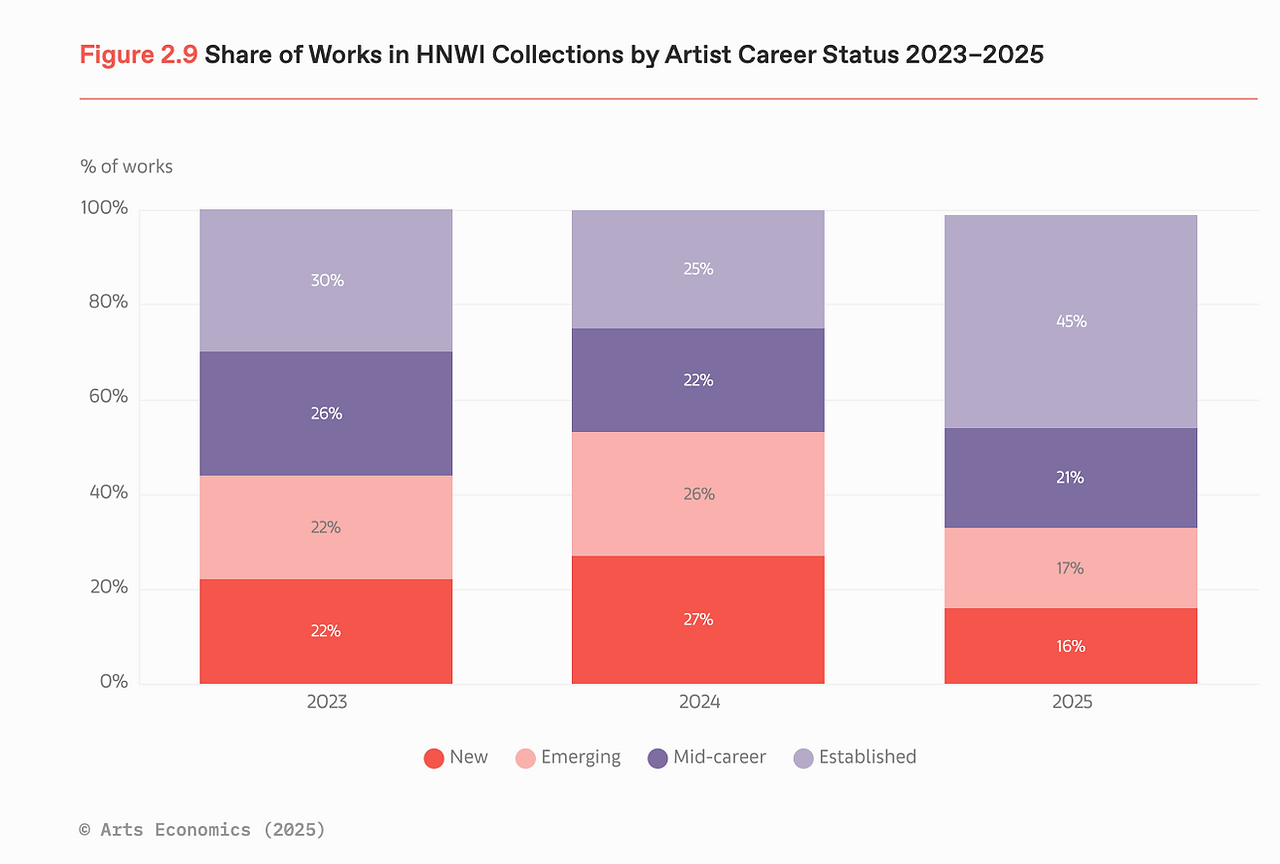
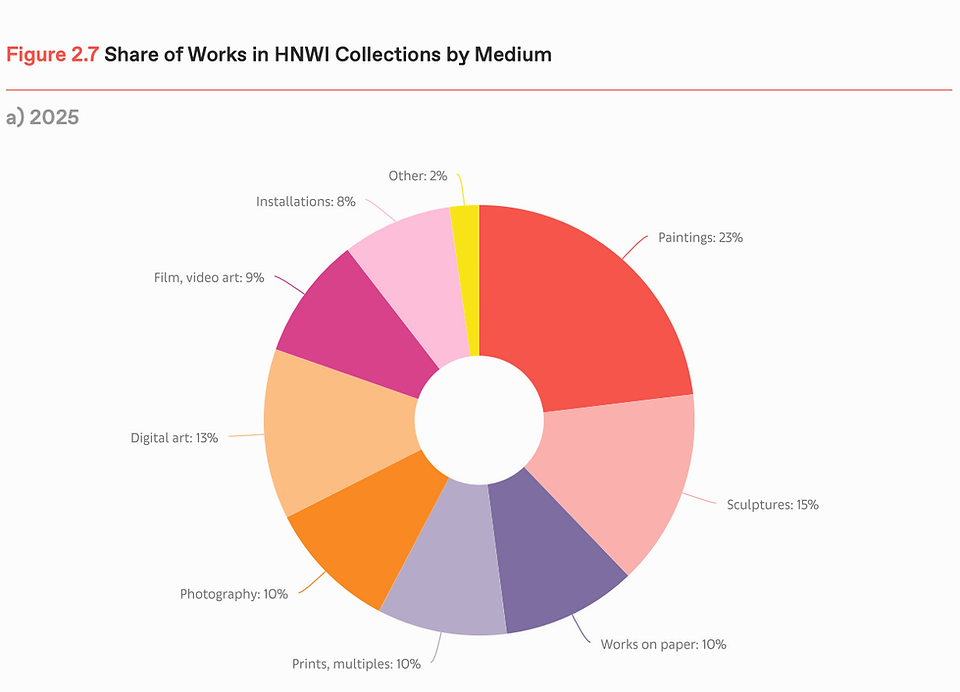


Some useful data offering insights into spending habits, sales channels, portfolio allocation, and artist career stages from The Art Basel & UBS Survey of Global Collecting 2025 By Arts Economics © Arts Economics 2025
The Art of Buying: Quantity, Types of Artists & Artworks
How many artworks should I buy to start an art collection?
For complete beginners, collecting can start very simply, such as buying one artwork a year, either from the same artist or across different artists and mediums. If funds are tight, you could consider asking friends or family to contribute on special occasions such as birthdays or anniversaries. Over time, collections can grow steadily: surveys show the average collector owns around 40 works, with long-term collectors over 20 years averaging more than 100 works.
Should I buy artworks from living or dead artists?
When buying art, it helps to think about whether you want to support living artists as their careers grow, with clear and easy to access certificates of authenticity, or, own an older work with value backed by auction records and sales history. While historic works can feel special and rare, they are often too expensive for beginner collectors and may come with challenges such as being in poor condition or missing documentation. In 2025, high-net-worth art collectors held an even split in their collections, with roughly half of works by living artists and half by deceased ones.
What is the best medium of art to collect?
There is no single “best” art medium to collect, but paintings remain the most popular and reliable choice, making up around 23% of collections across all ages, wealth levels and experiences of collecting. If you want to change it up, interest has grown in 2025 for digital art, film, video, photography, and sculpture, shying away from more traditional options like prints and photography. That said, prints, multiples and photography work for a reason; they are popular entry points thanks to their affordability and accessibility as little as £50. That's why HNWI's have 20% of their collections in this area.
What kind of artist should I invest in?
When investing in art, an artist’s career stage plays a big role in cost, risk, and potential return. Emerging, established, and blue-chip artists all come with different prices, risks, and rewards, so choosing the right one depends on how much you want to spend and how much risk you’re comfortable with.
Emerging Artist (£)
Buy early and cheaply, which is why emerging artists are often a good place to start. While riskier, collectors buy their work hoping it will grow in value over time, and around 18% of HNWI collections currently focus on artists at this early stage.
Career length: 0–10 years
Pricing: £100 - £10,000
Exhibitions: Early solo or group shows at smaller or regional galleries, project spaces, or art fairs.
Auction presence: Little to no auction history.
Institutional interest: Small museums or collections.
Collector base: First-time buyers and early supporters.
Examples: Holly Stevenson, Sophie Birch, Shaqúelle Whyte
Established or mid-career artists (££)
If emerging artists feel too risky, established or mid-career artists are a safer next step. They cost more, but they have proven demand, consistent sales, and a track record that makes them more reliable, with around 21% of HNWI collections focused on artists at this stage.
Career length: 0–10 years
Pricing: £100 - £10,000
Exhibitions: Early solo or group shows at smaller or regional galleries, project spaces, or art fairs.
Auction presence: Little to no auction history.
Institutional interest: Small museums or collections.
Collector base: First-time buyers and early supporters.
Examples: Salman Toor, Daisy Parris, Toyin Ojih Odutola, Amaoako Boafo, Jadé Fadojutimi
Blue-Chip Artists (£££)
Blue-chip artists are the biggest and most established names in the art world, making them the safest but most expensive option to collect. Their value is built on long-term cultural importance, strong museum presence, and years of high-value auction sales, rather than trends or hype.
Career length: 15–25+ years
Pricing: £500,000 to tens of millions
Exhibitions: Major retrospectives and permanent displays in the world’s leading museums.
Auction presence: Auctioned consistently 10+ years
Institutional interest: Widely collected by top international museums, foundations, and cultural institutions.
Collector base: Ultra-high-net-worth collectors and global institutions
Examples: Claude Monet, Pablo Picasso, Paul Cézanne, Banksy and Damien Hirst
What are some green flags to look for when investing in artists or artworks?
At Artelier, we use a proven formula made up of 7 criteria to spot the best established and emerging artists to invest in. While the actual guidelines are top secret, we can provide some loose guidelines on what makes a standout artwork or artist below, regardless of their price. Key signals to look for include:
Recognition & track record
Regular exhibitions at respected galleries
Acquired by museums, shows or biennales
Representation by well known galleries
Proof of awards, grants, or artist residencies
A consistent working record, not just a fleeting 'hype' trend
History of pricing & buyers
A growing collector base, including institutional buyers
Fair and consistent pricing with no sudden spikes or heavy discounting
Artwork quality & practice
A clear, recognisable artistic practice that evolves over time
High-quality work that is identifiable to the artist and their style. What does high-quality mean in this sense? Does it convey a clear idea? Is it original in idea rather than being trend-driven?
Paperwork, availability & condition
Clear documentation and provenance records
Artworks in good condition with minimal damage
Rarity in artworks, including unique works or limited editions
Where are the best places to buy art?
Buying art today isn’t limited to traditional auction houses anymore. You no longer need insider access to the art world, or feel limited to the options of galleries only available in your local town. Today, most collectors acquire art through three channels: offline via auction houses, dealers, galleries, and fairs; online through digital platforms; or directly from artists.
Auction Houses, Dealers, Galleries & Fairs
While auctions and dealers continue to account for much of the market’s value, they represented just 12% percent of transactions in 2024-25. In-person buying has increasingly shifted toward galleries, dealer-led sales (often online or via email), and art fairs, with dealers remaining the most trusted and highest-spend channel in 2025.
Online Platforms
For contemporary art, platforms like Artnet and Artsy are easy places to start, while historical works are best found through auction houses such as Bonhams and Christie’s, which run themed sales throughout the year and can be tracked via their calendar.
Directly with the artists
One of the best places to buy art today is directly from artists themselves. Platforms like Instagram have played a major role in this shift, allowing collectors to follow artists’ work in real time, communicate directly, arrange studio visits, and access new pieces early, often at more affordable prices. For beginners, buying directly from artists makes it easier to discover emerging talent at the tap of a screen, build genuine relationships, and enter the art market in simply and informally.

The Art of Being Organised: Administration & Extra Costs
What paperwork comes with investing in art?
Owning an artwork is one thing, but proper documentation is a must. There’s no point in making big investments without a clear record of an artwork’s history. When investing in art, important paperwork includes:
Legal & Ownership
This includes certificates of authenticity, invoices, and contracts that prove the artwork is genuine and legally yours. Proper documentation is essential for insurance, future resale, and protecting yourself from buying fakes.
Provenance
Provenance is the ownership history of an artwork and shows where it has been over time, such as past collectors, galleries, or museums. A clear and credible provenance increases trust in the work and can significantly improve its value and ease of resale.
Inventory & Condition Reports
An inventory is a detailed record of your artworks, including images, descriptions, purchase details, and locations. Keeping an up-to-date inventory helps with organisation, insurance claims, estate planning, and managing your collection as it grows.
Additional fees easily overlooked when buying art
The price tag on an artwork is rarely the final price. A safe rule of thumb is to budget an extra 10–30% on top of the artwork cost to cover extra fees, especially when buying through auctions or internationally.
People don’t always realise how many extra costs can come with buying art. If you’re buying at auction, for example, you’re usually paying a buyer’s premium of around 20–30%, plus taxes and sometimes artist resale royalties of about 4–5%. Then you have service fees of advisors, dealers or galleries which cover their sourcing, expertise and access to works. Then there are the less obvious costs: shipping can add 1–5% (more for international or fragile works), framing and conservation can range from a few hundred pounds to several thousand, and higher-value works may need ongoing care at around 1–2% per year. On top of that, appraisals can cost anywhere from £200 to £1,000+, and import taxes, VAT, and duties can add another 5–20%. It all adds up quickly, which is why understanding the full picture matters before you buy.
Talia Hacker, Project Manager & Curator at Artelier Art Consultancy
Talia has experience sourcing artworks for leading international projects, working closely with galleries, and managing global logistics and documentation.

The Art of Planning: Basic Guidelines & Professional Advice
If I were to make a plan to start buying art in 2026, what would be a good structure?
Investing in art can feel overwhelming, but this guide breaks the process into clear, manageable steps to help you start collecting with confidence in 2026.
1
Look before you buy
Visit galleries, museums, fairs, and browse online. Note what you like and dislike. No buying yet.
2
Choose a focus
Choose a type or theme of art you genuinely enjoy so you can study it in depth. it could be Impressionism, archive photography, or American folk art.
3
Set your goals
Decide if you’re buying for enjoyment, investment, or both, and how long you’re happy to hold the work.
4
Set a realistic budget
Decide what you can comfortably spend now and what you can spend regularly. Start small if needed. Consistency matters more than size.
5
Do your research
Read books and catalogues, follow artists and galleries, and learn basic market terms (pricing, editions, provenance).
6
Shortlist artists or styles
Choose 3–5 artists (or a few types of work) you’re drawn to. Track their prices, where they sell, and how often their work appears.
7
Start talking to the market
Speak with galleries, dealers, and artists. Ask questions, compare prices across platforms, and don’t rush. Confidence comes from repetition.
8
Make your first purchase carefully
Buy something you truly like and can afford to hold long-term. Check authenticity, paperwork, and ownership history. Make sure you can store and care for it properly.
9
Improve, adapt & overcome
After buying, reflect on what went well and what you’d change. Then repeat the process: refine your taste, build relationships, and grow your collection slowly and intentionally.
Can’t I do this on my own? What can art professionals actually help me with that I can’t do myself?
Trying to invest in art without professional help can be risky, especially for beginners.
The art market is largely unregulated, prices aren’t always transparent, and it’s easy to overpay, buy the wrong work, or miss serious red flags around authenticity and ownership. Many artworks are never publicly listed, and without insider knowledge you’re often seeing what’s left, not what’s best. From the NFT boom, where many works lost most of their value almost overnight, to famous forgery cases like Han van Meegeren, even experienced collectors have been misled.
Art advisors, dealers, and legal specialists exist to protect you from those risks. They know how to spot inflated prices, weak provenance, and unstable artist markets before problems come up. Just as you wouldn’t manage complex finances without an accountant or lawyer, navigating the art world alone leaves you exposed to fakes, illiquid assets, and hard-to-sell mistakes.
Just like using an accountant or lawyer, professional art advice isn’t luxury; it’s a safeguard for your money, your time, and your long-term investment goals.

Start Investing with Artelier Art Consultancy
Art is a great way to add long-term value to your investment portfolio. It helps you build an asset base that can grow and last for generations to come, for those thinking in the interests of their family and their legacy. With clear goals, a bit of research, and the right professional support, collecting art is no longer intimidating but fun and rewarding.
At Artelier, we focus on art investment, art consultancy, and concierge services, working across modern, contemporary, emerging, and blue-chip artists. Through our Art Investment Concierge Service, we help clients find investment-grade works, access off-market opportunities, and build collections that suit their taste, budget, and long-term plans, whether you’re starting fresh or adding to an existing collection.
With over 20 years of experience and recognition from leading global brands, Artelier’s Art Concierge offers hands-on support from start to finish. From shaping a strategy and sourcing works to guiding you at art fairs, commissioning bespoke pieces, and managing installation, we make the process simple. If you’d like to explore further, you can also check out our guide to 40 of the world’s top art advisors by genre, or get in touch to arrange a call with one of our art consultants.
About the Writers

Océane Pouélé
Curator, Researcher and Editor
Océane has trained in the UK and Italy, under world class artists specialised in printmaking, classical drawing and painting. Combined with her experience in the museum sector, this has given her a deep understanding of the artistic process. Océane is passionate about working with artists and has specialist experience collaborating with artists for the company's curatorial and editorial projects.

Ella Forster
Senior Curator, Researcher and Editor
Ella holds a BA in History & French from King's College London, complemented by a year of international study focused on History of Art at the University of Montréal. Fluent in English and French, Ella has immediate experience consulting private clients on art collection management, including advising on market trends, cataloguing and optimising storage methods. Explore our other team members here.